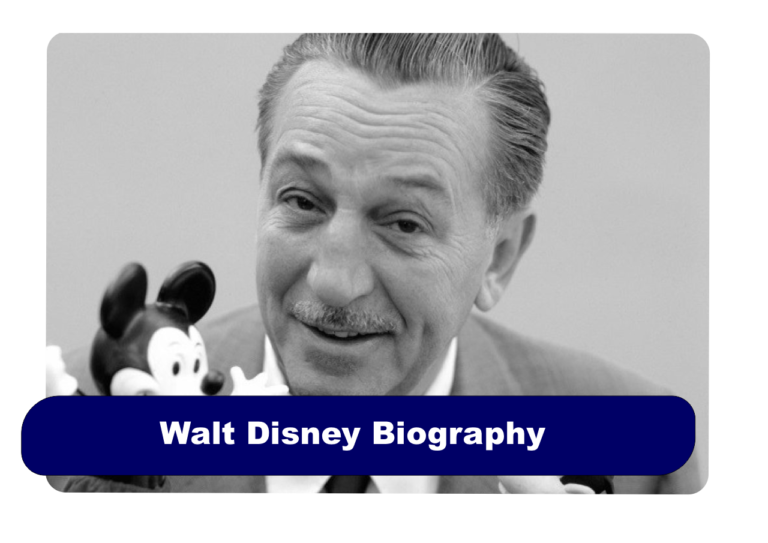
Walt Disney was a visionary animator, filmmaker, and entrepreneur born in 1901. Discover his early life, iconic movies, theme parks, 22 Oscar wins, and enduring legacy.
Walt Disney was not simply an entertainer — he was an architect of imagination. Born in Chicago in 1901, he built one of the most recognizable creative empires in history, giving the world Mickey Mouse, Snow White, Disneyland, and a storytelling philosophy that still shapes global culture today. Few individuals have left a deeper imprint on childhood, film, and popular imagination than Walter Elias Disney.
What made Disney extraordinary was his refusal to accept limits. He was a man who went bankrupt before he turned 25, lost the rights to his first successful cartoon character, and still pressed forward — eventually winning 22 Academy Awards, more than any individual in history, and opening a theme park that redefined leisure itself. His story is one of relentless reinvention.
Quick Facts About Walt Disney
| Detail | Information |
|---|---|
| Full name | Walter Elias Disney |
| Date of birth | December 5, 1901 |
| Date of death | December 15, 1966 (aged 65) |
| Birthplace | Chicago, Illinois, USA |
| Profession | Animator, film producer, director, entrepreneur |
| Net worth at death | ~$100–150 million (approx. $1 billion+ inflation-adjusted) |
| Spouse | Lillian Bounds (married 1925) |
| Children | Diane Marie Disney, Sharon Mae Disney (adopted) |
| Company founded | Walt Disney Productions (1923) |
| Famous for | Mickey Mouse, Disneyland, Snow White, 22 Academy Awards |
Early Life and Family
Walter Elias Disney was born on December 5, 1901, in the Hermosa neighborhood of Chicago, Illinois, to Elias Disney and Flora Call Disney. He was the fourth of five children, growing up alongside brothers Herbert, Raymond, Roy, and sister Ruth. His father Elias was a strict, often difficult man who moved the family frequently in search of better opportunities — a pattern that shaped Walt’s restless, forward-looking temperament.
In 1906, the family relocated to a farm in Marceline, Missouri, a small town that would prove formative for young Walt. It was here that he developed his love of drawing, sketching animals on any paper he could find. Marceline left such a lasting impression that it later served as the direct inspiration for Main Street, U.S.A. in Disneyland. The town’s small-town Americana aesthetic became a permanent thread running through everything Disney created.
The family moved again in 1911, this time to Kansas City, Missouri, where Walt attended Benton Grammar School and befriended Walter Pfeiffer, who introduced him to vaudeville and motion pictures — his first real exposure to the world of performance and spectacle. He attended Saturday classes at the Kansas City Art Institute, developing his drafting skills with quiet seriousness.
Education and Early Artistic Training
Disney’s formal education was fragmented by the family’s constant moves. He attended McKinley High School in Chicago after the family returned in 1917, where he served as cartoonist for the school newspaper and enrolled in night courses at the Chicago Academy of Fine Arts. His academic performance was unremarkable — he was far more interested in drawing than studying.
At sixteen, he dropped out of school to enlist in World War I, but was rejected for being underage. He joined the Red Cross instead and drove an ambulance in France, covering it in his own cartoon drawings. By the time he returned to the United States in 1919, he was nineteen years old, nearly broke, and determined to build a career in commercial art.
Building an Empire: From Laugh-O-Gram to Hollywood
Disney’s first independent venture, Laugh-O-Gram Studio in Kansas City, produced short animated fairy tales and showed early promise — but went bankrupt in 1923, leaving him with little more than a suitcase and unfinished footage. Undeterred, he boarded a train to Los Angeles with $40 in his pocket and the ambition to break into the film industry.
In Hollywood, Disney partnered with his brother Roy and founded the Disney Brothers Studio in 1923, which later became Walt Disney Productions. His early success came from the Alice Comedies, a series combining live-action and animation. This was followed by Oswald the Lucky Rabbit, which became a genuine hit — until Disney discovered that Universal Pictures owned the character, not him. Losing Oswald was a defining blow that taught him one of the central lessons of his career: always retain ownership.
The loss of Oswald directly led to the creation of Mickey Mouse in 1928. Disney and his chief animator Ub Iwerks designed the character together, and it was Lillian Disney, Walt’s wife, who suggested the name “Mickey” over Walt’s original choice of “Mortimer.” Steamboat Willie, Mickey’s debut short, was one of the first cartoons to feature synchronized sound — a technological leap that made it a sensation and established Disney as an industry innovator almost overnight.
The Golden Age: Snow White to Fantasia
Having secured his foothold with Mickey Mouse, Disney set his ambitions far higher. In 1937, he released Snow White and the Seven Dwarfs — the first feature-length animated film ever produced. Hollywood called it “Disney’s Folly” before it came out, convinced no audience would sit through an animated feature. It became the highest-grossing film of 1938 and earned Disney an honorary Academy Award consisting of one full-sized Oscar and seven miniature ones.
The films that followed — Pinocchio (1940), Fantasia (1940), Dumbo (1941), Bambi (1942), Cinderella (1950), and Peter Pan (1953) — cemented Disney’s studio as the gold standard of animated filmmaking. Each film pushed the technical and artistic limits of what animation could achieve, and several are still regarded among the greatest films ever made. Disney was not simply producing cartoons; he was constructing an entirely new visual language for storytelling.
Disneyland and the Birth of the Theme Park
By the early 1950s, Disney had turned his attention to an entirely new medium: physical space. Inspired partly by the dull experience of accompanying his daughters to amusement parks, he envisioned a place where families could enter a story together. He purchased 160 acres of orange groves in Anaheim, California, and set about building Disneyland.
It opened on July 17, 1955 — a day marked by chaos and widely panned by critics, who called it a disaster. Within weeks, however, the park was drawing enormous crowds. Within a year, it had welcomed one million visitors. Disneyland was unlike anything that had existed before: themed lands, costumed characters, immersive storytelling woven into every corner. It didn’t just entertain visitors; it transported them. The modern theme park industry was born on that single day.
Disney began secretly purchasing land in central Florida in the early 1960s under shell companies, planning a far larger project. Walt Disney World opened in 1971, five years after his death, fulfilling a vision he spent his final years designing in meticulous detail.
Television and Later Career
Disney was also a pioneer in television, launching the Disneyland anthology series on ABC in 1954 — one of the first major studio forays into the medium. The show was a ratings success and gave Disney a powerful platform to promote the park before it even opened. The Mickey Mouse Club followed in 1955, becoming a defining program for a generation of American children.
His final years saw him working simultaneously on The Jungle Book (1967), his last animated film, and the conceptual plans for what he called EPCOT — an Experimental Prototype Community of Tomorrow — a fully planned, futuristic city in Florida. He never saw either completed. Walt Disney died of lung cancer on December 15, 1966, just ten days after his 65th birthday.
Personal Life
Disney married Lillian Bounds in 1925, having met her while she worked as an ink artist at his studio. The marriage lasted until his death — 41 years. They had one biological daughter, Diane Marie Disney, and adopted a second daughter, Sharon Mae Disney. By all accounts, Disney was a devoted father, though colleagues described him as exacting and often difficult in the workplace — a perfectionist who could be both inspiring and exhausting to work with.
He was a chain-smoker throughout his adult life, a habit that almost certainly contributed to his death. He lived in a Tudor-style home in Holmby Hills, Los Angeles, and maintained a retreat in Palm Springs. Despite his enormous wealth, he was known for reinvesting nearly every dollar back into his projects rather than accumulating personal luxury.
Net Worth and Financial Legacy
At the time of his death in 1966, Walt Disney’s personal net worth was estimated at between $100 million and $150 million, with the bulk of his wealth tied up in Walt Disney Productions stock, real estate holdings, and his stake in WED Enterprises (now Walt Disney Imagineering). Adjusted for inflation to 2026 values, this represents approximately $1 billion or more. The Walt Disney Company, which he founded, is today worth well over $200 billion — a testament to the enduring commercial power of what he built.
Awards and Recognition
Disney’s record of 22 competitive Academy Awards from 59 nominations remains unmatched by any individual in history. He received a special Academy Award for Snow White in 1939, won the Cecil B. DeMille Award from the Golden Globes in 1953, and was honored with Primetime Emmy Awards for his television work. He received the Presidential Medal of Freedom in 1964 — the United States’ highest civilian honor. He holds a star on the Hollywood Walk of Fame, and was posthumously inducted into the Television Hall of Fame in 1986.
Final Thoughts
Walt Disney’s life reads like one of his own fairy tales — full of early hardship, stubborn belief, spectacular failure, and ultimately, world-changing triumph. He was bankrupted, cheated, dismissed, and doubted at nearly every stage, and each time he responded with a larger vision than the one before. The empire he built did not survive him in spite of his personality; it survived because of the depth of his imagination and the discipline with which he pursued it.
More than half a century after his death, Disney’s name is still the first word children learn to associate with magic. That may be his most extraordinary achievement of all — not the 22 Oscars, not the theme parks, not the studio — but the simple, durable fact that he made wonder feel like a destination anyone could reach.
People Also Ask
What is Walt Disney best known for?
Walt Disney is best known for creating Mickey Mouse, producing the first feature-length animated film (Snow White and the Seven Dwarfs), and founding Disneyland. He also holds the record for the most Academy Awards won by a single individual — 22 in total.
When did Walt Disney die and what was the cause?
Walt Disney died on December 15, 1966, just ten days after his 65th birthday. The cause of death was lung cancer, which was linked to his lifelong habit of heavy smoking.
Who created Mickey Mouse?
Mickey Mouse was created in 1928 by Walt Disney and his chief animator Ub Iwerks. Walt’s wife Lillian suggested the name “Mickey,” replacing Walt’s original choice of “Mortimer Mouse.”
Did Walt Disney go bankrupt?
Yes. His first independent studio, Laugh-O-Gram in Kansas City, went bankrupt in 1923. He moved to Hollywood with $40 and rebuilt from scratch, co-founding what would become Walt Disney Productions with his brother Roy.
What happened to Walt Disney’s plans for Florida?
Disney spent his final years secretly purchasing land in central Florida and planning Walt Disney World, including an experimental planned city called EPCOT. He died in 1966 before either was completed. Walt Disney World opened in 1971, though the EPCOT concept was significantly modified from his original vision.