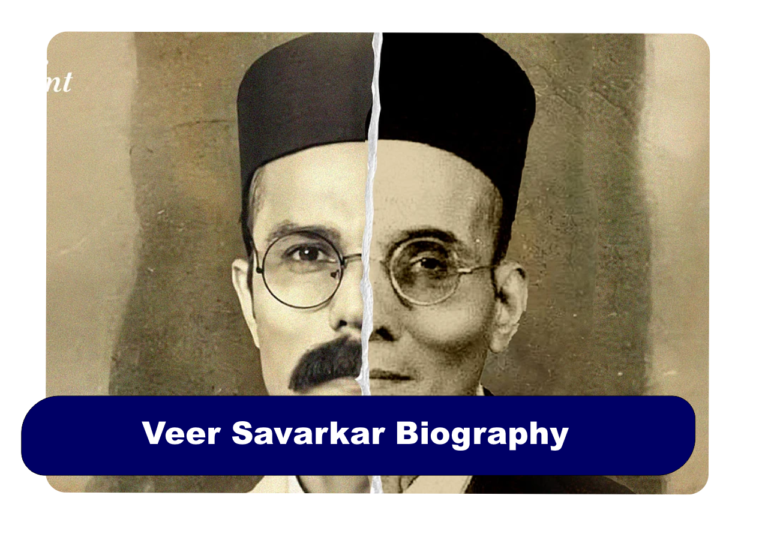
Veer Savarkar (1883–1966) was an Indian revolutionary, freedom fighter, and originator of Hindutva. Explore his life, imprisonment in Cellular Jail, ideology, and contested legacy.
Vinayak Damodar Savarkar — known to history as Veer Savarkar — was one of the most extraordinary and fiercely debated figures to emerge from India’s freedom struggle. Born in 1883 in Maharashtra, he was simultaneously a revolutionary activist, a poet of considerable power, a political philosopher, and a social reformer. His ideas defined a strand of Indian nationalism that still shapes the country’s politics more than half a century after his death.
He was the man who described the 1857 uprising as India’s first war of independence, who founded underground revolutionary cells from Pune to London, who endured a decade in what was arguably the harshest prison the British Empire ran, and who coined the term Hindutva — a word that remains at the center of India’s most contested political conversations today.
Quick Facts About Veer Savarkar
| Detail | Information |
|---|---|
| Full Name | Vinayak Damodar Savarkar |
| Born | May 28, 1883 |
| Birthplace | Bhagur village, Nashik district, Maharashtra, India |
| Died | February 26, 1966 (aged 82) |
| Death Place | Savarkar Sadan, Bombay (now Mumbai) |
| Profession | Revolutionary, political thinker, writer, poet, lawyer, social reformer |
| Known For | Hindutva ideology; Abhinav Bharat Society; imprisonment in Cellular Jail |
| Political Party | Hindu Mahasabha (President, 1937–1943) |
| Notable Works | The Indian War of Independence, 1857; Hindutva: Who is a Hindu? |
| Father | Damodar Savarkar |
| Spouse | Yamuna Bai (Maisaheb) |
| Death Cause | Self-imposed fast (Atmaarpan) from February 1, 1966 |
Early Life and Awakening in Bhagur
Vinayak Damodar Savarkar was born on May 28, 1883, in the small village of Bhagur near Nashik in Maharashtra. He was the eldest of four siblings, raised in a household where his father Damodar nurtured a love of learning and patriotic feeling. From childhood, Savarkar displayed unusual intellectual sharpness and a deep hunger for stories of resistance against British rule.
The India of his childhood was a country still processing the consequences of 1857 — the revolt the British called the Sepoy Mutiny, but which Savarkar would later reframe as a deliberate national uprising. Growing up in Maharashtra also meant growing up in the shadow of Bal Gangadhar Tilak, whose assertive brand of nationalism left an unmistakable mark on the young Savarkar.
As a high school student, he was already politically active. He co-founded a youth group called Mitra Mela in 1903, which evolved into the Abhinav Bharat Society in 1904 — a secret revolutionary organization whose stated aim was the complete overthrow of British rule. He was barely twenty years old. By the time he enrolled at Fergusson College in Pune, the trajectory of his life was set: not law, not commerce, but revolution.
London, Gray’s Inn, and the Underground Network
In 1906, Savarkar traveled to London on a scholarship to study law at Gray’s Inn. What looked on paper like a respectable legal career was, in practice, nothing of the sort. At India House in London, he found a network of passionate anti-colonial activists and threw himself into organizing it with characteristic intensity.
He connected with figures including V.V.S. Aiyar, Madame Cama, and Har Dayal, using India House as a base to expand the international reach of Abhinav Bharat. He translated Giuseppe Mazzini’s autobiography into Marathi, sending the Italian nationalist’s ideas of sacrifice and self-determination to a Maharashtrian readership hungry for exactly that kind of inspiration.
His most significant London-era work was The Indian War of Independence, 1857 — a book that argued the 1857 uprising was not a mutiny but a coordinated national revolt. The British authorities were alarmed enough to ban it before it was even formally published. It was smuggled into India and circulated clandestinely for decades. Savarkar was now firmly on the British intelligence radar as one of the most dangerous Indian nationalists operating abroad.
Arrest, Trial, and the Kala Pani
In 1910, Savarkar was arrested in London for his role in procuring firearms and smuggling them to India, and for alleged links to the assassination of British official A.M.T. Jackson in Nashik. The circumstances of his extradition became notorious: while being transported back to India aboard a ship docked at Marseilles, he jumped overboard and swam to the French shore, attempting to claim asylum. French authorities returned him to British custody, and the legal controversy over that handover became an international incident.
He was convicted on charges of sedition and conspiracy, and sentenced to two consecutive life terms totalling 50 years — designed to ensure he spent the rest of his life confined to the Cellular Jail in Port Blair, in the Andaman Islands, known in India as Kala Pani (Black Waters).
The conditions at the Cellular Jail were brutal by any measure. Prisoners were subjected to solitary confinement, physical beatings, iron fetters, forced labor — including being yoked to oil-extraction mills — chronic hunger, and systematic humiliation. Savarkar spent nearly a decade there, suffering dysentery, lung disease, and malaria. His elder brother Ganesh was imprisoned there alongside him. That he endured a decade in those conditions and retained both his sanity and his ideological clarity is itself a remarkable fact.
He submitted petitions to the British government requesting clemency during his imprisonment — a matter that has been contested ever since. His defenders argue these were strategic moves to secure release so he could continue his work from outside prison. His critics view them as inconsistent with his revolutionary rhetoric. Historians across the political spectrum have examined the same documents and reached different conclusions.
Release, House Arrest, and the Hindutva Thesis
Savarkar was released from the Andamans in 1921 and transferred to Ratnagiri, where he remained under strict house arrest until 1937 — confined to the district, his political activities severely curtailed. It was during this long period of enforced confinement that he produced his most intellectually significant work.
In 1923, he wrote Hindutva: Who is a Hindu? — a political treatise that attempted to define Hindu identity not in strictly religious terms but in geographic, cultural, and civilizational ones. Savarkar argued that a Hindu was anyone who regarded the Indian subcontinent as both their fatherland (Pitribhumi) and their holy land (Punyabhumi). The text was an attempt to construct a unified Hindu political identity that could serve as the basis for Indian nationhood.
Savarkar was explicit that his conception was cultural and political, not theological — he was, in fact, a rationalist and skeptic for much of his adult life. However, the framework he constructed has been interpreted and deployed in many directions since, including some he may not have intended. Hindutva: Who is a Hindu? remains one of the most cited and most disputed texts in the history of Indian political thought.
The Hindu Mahasabha Years
In 1937, after nearly two decades of various restrictions, Savarkar was finally free to participate in public life. He joined the All-India Hindu Mahasabha and was elected its president — a position he held for seven years. He positioned himself as a counterweight to both the Indian National Congress and the Muslim League, pushing for Hindu military mobilization and encouraging young Hindus to enlist in the British Indian Army — not out of loyalty to the Empire, but on the calculation that military training would be invaluable for an independent India.
He was also a vocal opponent of Gandhi’s non-violence as a strategic doctrine, arguing it was insufficient against imperial power. His relationship with Gandhi was one of ideological antipathy, though events after 1948 would make even that distinction difficult to sustain in public memory.
Social Reforms: A Less-Discussed Dimension
One dimension of Savarkar’s legacy that receives less attention than his political ideology is his record as a social reformer. During his years under restriction in Ratnagiri, he organized sustained campaigns against caste discrimination — hosting inter-caste dining halls, leading community meals that brought together Brahmins and lower-caste Hindus at the same table, and building the Patit Pavan Temple, explicitly open to all Hindus regardless of caste at a time when temple entry for Dalits was still violently opposed across much of India.
He was among the earliest prominent voices to call for the abolition of untouchability in concrete terms, arguing that Hindu society could not be politically effective while internally divided by caste hierarchy. These campaigns placed him — in social terms — closer to B.R. Ambedkar’s positions than to many of his own political contemporaries. That this dimension of his work sits awkwardly alongside other aspects of his legacy is part of what makes him so difficult to categorize cleanly.
The Gandhi Assassination Case and Later Years
On January 30, 1948, Mahatma Gandhi was assassinated by Nathuram Godse — a Hindu nationalist with ties to the Hindu Mahasabha. Savarkar was arrested as an alleged co-conspirator. The trial was one of the most politically charged in Indian history. He was ultimately acquitted due to insufficient evidence.
The acquittal did not restore his public standing. After 1948, Savarkar largely withdrew from active politics, spending his remaining years in Bombay. His reputation in the decades immediately following independence was shaped largely by the Congress Party’s political narrative, which cast him in an unfavorable light. His name appeared on streets and institutions in Maharashtra, where he retained a loyal following, but at the national level he was sidelined from the official pantheon of freedom fighters.
In 1964, Savarkar announced his intention to fast unto death — what he described not as suicide but as Atmaarpan (self-surrender). He wrote a final essay titled Atmahatya Nahi Atmaarpan (Not Suicide, but Self-Surrender), arguing that when a person’s life mission is complete and they can no longer contribute meaningfully, they have the right to exit on their own terms. He stopped eating, drinking, and taking medication on February 1, 1966, and died on February 26, 1966, at the age of 82, at his residence in Bombay.
Legacy and Contested Memory
Savarkar’s legacy is genuinely contested — not as a polite acknowledgment of complexity, but as a live, unresolved argument in Indian politics. His admirers, particularly in the BJP and RSS traditions, regard him as a visionary patriot who suffered enormously for India’s freedom and whose ideas about Hindu civilization were vindicated by history. His critics, primarily on the left and among minority communities, view his Hindutva framework as the ideological root of Hindu majoritarian politics.
His birth anniversary, May 28, is celebrated annually as Savarkar Jayanti. The Port Blair airport in the Andaman Islands — where he spent a decade in the Cellular Jail — was renamed Veer Savarkar International Airport in 2002. His portrait hangs in the Central Hall of India’s Parliament. The debate over whether he deserves the Bharat Ratna, India’s highest civilian honor, remains politically active decades after his death — a measure of how unfinished the reckoning with his life still is.
Wrapping Up
Veer Savarkar lived a life of extraordinary intensity: underground revolutionary at twenty, political prisoner at twenty-six, ideological architect of Hindu nationalism in his thirties, social reformer in his forties, national politician in his fifties, accused conspirator in his sixties, and a man who chose the terms of his own death in his eighties.
His thought was shaped by the experience of colonialism, by his encounter with European nationalist movements, by the brutality of Kala Pani, and by an anxious reading of Hindu society’s internal divisions. Whether one regards his conclusions as prescient or dangerous — and serious historians have argued both — his influence on the political culture of independent India is undeniable and ongoing.
He remains one of the most studied and least simply understood figures in modern Indian history.
People Also Ask
Who was Veer Savarkar?
Veer Savarkar (1883–1966) was an Indian independence activist, political thinker, and writer whose full name was Vinayak Damodar Savarkar. He is best known for coining the political philosophy of Hindutva and for his decade-long imprisonment in the Cellular Jail at Port Blair in the Andaman Islands.
What is Hindutva and who created it?
Hindutva is a political ideology that defines Hindu identity in cultural, geographic, and civilizational terms rather than purely religious ones. It was articulated by Savarkar in his 1923 pamphlet Hindutva: Who is a Hindu?, written during his years under house arrest in Ratnagiri, and has since become the foundational philosophy of India’s Hindu nationalist political movement.
Was Savarkar involved in Gandhi’s assassination?
Savarkar was tried as an alleged co-conspirator in the January 1948 assassination of Mahatma Gandhi, carried out by Nathuram Godse. He was acquitted by the court due to insufficient evidence. The question of his moral or political responsibility continues to be debated by historians.
Why did Savarkar write mercy petitions to the British?
During his imprisonment at the Cellular Jail, Savarkar submitted petitions requesting clemency from the British. His supporters argue these were strategic moves to secure release so he could continue the freedom struggle outside prison. Critics view them as inconsistent with his revolutionary rhetoric. The debate is ongoing, and the original documents are interpreted differently by historians across the political spectrum.
How did Veer Savarkar die?
Savarkar died on February 26, 1966, in Bombay, following a self-imposed fast that he had begun on February 1. He described this act in a final essay as Atmaarpan — the conscious conclusion of a life once its mission is fulfilled — not suicide.