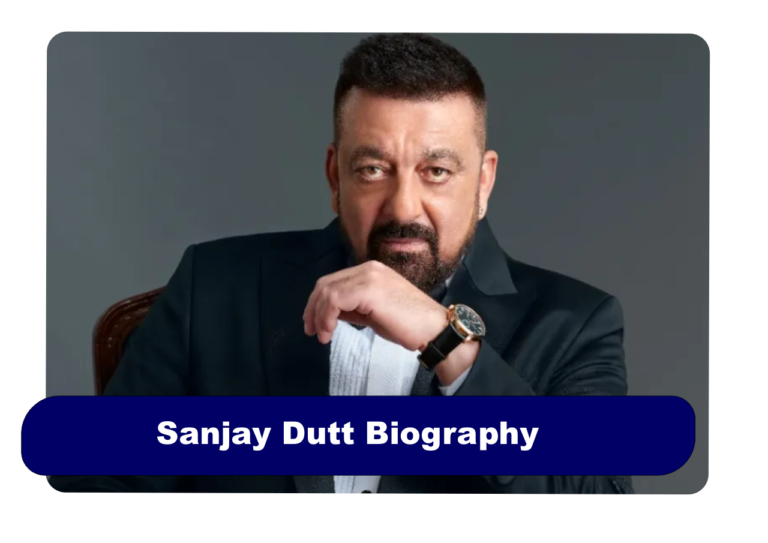
Sanjay Dutt, born July 29, 1959, is a Bollywood legend known for Munna Bhai, Vaastav & KGF 2. Explore his life, drug battle, jail sentence & inspiring comeback.
Sanjay Dutt is one of the most complex and compelling figures Bollywood has ever produced. Across a career spanning more than four decades, he has been a superstar, a convicted felon, a cancer survivor, and one of Hindi cinema’s most beloved comeback stories — sometimes all at once. Born into cinematic royalty and tested by personal tragedy in almost every decade of his life, he has earned his nickname “Sanju Baba” not just as a term of endearment but as a kind of shorthand for survival.
His story is genuinely cinematic: a son whose mother died days before his first film released, a man who battled drug addiction for nearly a decade, who walked into jail as a convicted man and walked out ready to work again. The 2018 Rajkumar Hirani biopic Sanju, with Ranbir Kapoor playing the lead, brought millions of new viewers to a life that had always been more dramatic than anything on screen.
Quick Facts About Sanjay Dutt
| Detail | Information |
|---|---|
| Full Name | Sanjay Balraj Dutt |
| Date of Birth | July 29, 1959 |
| Age | 66 (as of 2026) |
| Birthplace | Bombay (now Mumbai), Maharashtra, India |
| Profession | Actor, film producer, playback singer |
| Debut Film | Rocky (1981) |
| Father | Sunil Dutt (actor & politician) |
| Mother | Nargis Dutt (actress) |
| Sisters | Priya Dutt, Namrata Dutt |
| Wives | Richa Sharma (1987–1996, died); Rhea Pillai (1998–2008); Manyata Dutt (2008–present) |
| Children | Trishala Dutt (with Richa); Shahraan & Iqra (twins, with Manyata) |
| Education | The Lawrence School, Sanawar |
| Net Worth | ~₹295 crore (est. 2026) |
| Famous For | Munna Bhai M.B.B.S., Vaastav, Khalnayak, KGF: Chapter 2 |
Born Into Legend: Early Life in Mumbai
Sanjay Balraj Dutt was born on July 29, 1959, in Bombay, to two of Indian cinema’s most celebrated names. His father, Sunil Dutt, was a legendary actor turned politician. His mother, Nargis, was one of the most iconic actresses in Hindi film history — her performance in Mother India (1957) had made her a national institution. Growing up in that household meant growing up inside the very heart of Bollywood, and it shaped Sanjay’s world entirely.
He was educated at The Lawrence School in Sanawar, Himachal Pradesh — a residential school with a strong tradition in the arts — where he developed a love for music and discovered a genuine talent for guitar, later winning a gold medal in a competition in the United States. Despite the privilege of his upbringing, his early years were marked by emotional difficulty. His mother was diagnosed with pancreatic cancer while he was still a teenager, and her illness cast a long shadow over the years leading up to his film debut.
Nargis Dutt passed away on May 2, 1981 — just five days before the release of Rocky, Sanjay’s debut film, directed by his father. She never got to see her son on the silver screen. It was a grief that, by his own account, profoundly altered the course of his early adulthood.
The Debut and the Decade of Darkness
Rocky (1981) was a commercial hit and introduced Sanjay Dutt to Hindi cinema audiences as a fresh, muscular leading man with natural screen presence. But behind the launch of a promising career, Sanjay was sliding into drug addiction — a struggle that would dominate the better part of his twenties.
He has spoken candidly about the addiction in interviews, describing how the combination of his mother’s death, the pressures of overnight fame, and the wrong company created conditions for a decade-long battle with substance abuse. At his father’s insistence, he underwent rehabilitation in the United States, an experience he has called the most important turning point of his life. He returned to India clean and, by the late 1980s, was rebuilding a career that had been critically stalled.
His recovery coincided with a run of commercially successful films — Naam (1986), Tezaab (1988), Saajan (1991) — that re-established him as a bankable star. By the early 1990s, he had survived his first great crisis and appeared to be stepping into a more stable chapter of his life.
1993: The Arrest That Changed Everything
The 1993 Mumbai serial blasts killed 257 people and injured more than 700 in one of the worst terrorist attacks in India’s history. In April 1993, Sanjay Dutt was arrested under the Terrorist and Disruptive Activities Prevention Act (TADA) on charges of illegally possessing firearms — an AK-56 rifle, two pistols, and ammunition — that had been supplied to him by individuals later convicted in the blast conspiracy.
Dutt consistently maintained that he had sought the weapons to protect his family after receiving threats during the communal riots that preceded the blasts — his mother was Muslim and his father Hindu, making the family a visible target in the sectarian violence of that period. The court ultimately cleared him of conspiracy charges in 2007 but found him guilty of illegal arms possession under the Arms Act. He was sentenced to six years imprisonment, later reduced to five years by the Supreme Court in 2013.
He surrendered to custody in May 2013 and served his remaining sentence at Yerawada Central Jail in Pune, completing it and walking free in February 2016. His release was covered live by television channels across India. Emerging from prison, he told waiting cameras and fans: “I am here because of your support. And there is no easy road to freedom, my friends.”
Career-Defining Performances: Vaastav and Munna Bhai
Even as his legal troubles dragged on through the 1990s, Sanjay Dutt’s cinematic output during the period produced some of his finest work. Khalnayak (1993) had already become a cult classic before his arrest, with Dutt’s portrayal of the charismatic villain establishing a template he would return to in different registers throughout his career.
Vaastav: The Reality (1999) was a critical watershed. He played Raghu, a street-smart young man whose life spirals from neighborhood brawling into the Mumbai underworld — a performance of raw psychological depth that finally won him serious critical recognition and the Filmfare Award for Best Actor. Industry peers who had long admired his screen presence now acknowledged him as a genuine dramatic actor.
The Munna Bhai series, however, made him a phenomenon in a completely different register. Munna Bhai M.B.B.S. (2003) and Lage Raho Munna Bhai (2006), both directed by Rajkumar Hirani, cast him as a loveable, warm-hearted gangster who stumbles into medicine and Gandhian philosophy respectively. The character became one of Bollywood’s most beloved of the decade, introducing the phrase “Jadoo Ki Jhappi” (a magical hug) into everyday Indian vocabulary. The films were also genuinely socially resonant — the second installment inspired a nationwide conversation about Gandhian values and won a National Award.
His more recent work has shown an appetite for extending his reach. KGF: Chapter 2 (2022) cast him as the fearsome antagonist Adheera in the Kannada-language blockbuster — a pan-India film that demonstrated he could hold his own against new-generation action spectacle and connect with audiences across linguistic communities. Leo (2023) marked his debut in Tamil cinema.
Personal Life: Three Marriages and a Family
Sanjay Dutt’s personal life has been as eventful as his professional one. His first wife, Richa Sharma, was an actress he married in 1987. Their daughter Trishala was born in 1988. Richa was diagnosed with a brain tumour and passed away in 1996, leaving Sanjay to raise their daughter — who was eventually raised by her maternal grandparents in the United States, where she grew up.
He married model Rhea Pillai in 1998, but the marriage ended in 2008. That same year he married Manyata Dutt, a former background dancer, in a private ceremony. The two have been together since and have twins — a son, Shahraan, and a daughter, Iqra — born in 2010. Manyata has been widely credited as a steadying force in Sanjay’s life during his most turbulent years, including his prison term, which she attended as a regular visitor.
Cancer Battle and Recovery
In August 2020, during the COVID-19 lockdown, Sanjay was rushed to Mumbai’s Lilavati Hospital with breathlessness and chest pain. He tested negative for COVID-19, but doctors found fluid in his lungs, and further tests confirmed the diagnosis: lung cancer. He announced his illness publicly and immediately left for treatment abroad.
He returned to India in November 2020, declaring that he had completed his treatment and was on the road to recovery. He announced himself cancer-free and returned to film sets with characteristic speed, resuming multiple projects within months. His openness about the diagnosis and his recovery process was widely noted — both for the courage it represented personally and for the broader public conversation it sparked about cancer screening and early detection.
Net Worth and Business Interests
As of 2026, Sanjay Dutt’s estimated net worth stands at approximately ₹295 crore, built across four decades of film work, production ventures, and brand endorsements. He commands significant per-film fees and continues to attract major projects from across India’s regional film industries. In June 2023, he acquired stakes in the Zim Afro T10 cricket franchise Harare Hurricanes, expanding his interests beyond entertainment.
His upcoming projects include Aakhri Sawal, Raja Shivaji, Baap, and KD – The Devil, suggesting no deceleration in his on-screen ambitions.
The Biopic and a Legacy Examined
In 2018, Rajkumar Hirani — who had directed the Munna Bhai films — released Sanju, a biographical film about Sanjay Dutt’s life with Ranbir Kapoor in the title role. The film was a massive commercial success and reignited public debate about which version of Sanjay Dutt’s story deserves emphasis: the drug-addled young man who fell in with dangerous company, the committed actor who produced genuinely great performances, or the man who served his time and came home. The film was criticized in some quarters for being too sympathetic; in others, it was praised for humanizing a figure the media had long reduced to tabloid shorthand.
The debate around Sanju reflects the debate around Sanjay Dutt himself — a man whose life resists the clean arc of either a rise-and-fall story or a simple redemption narrative. He has been both villain and victim in his own story, sometimes simultaneously.
Wrapping Up
Sanjay Dutt turns 67 in July 2026 and shows no meaningful sign of stepping back. He is active across Bollywood and South Indian cinema, his fitness regimen legendary among co-stars, his appetite for work apparently undiminished by six decades of living at a very high temperature.
What makes him enduring isn’t the records or the box office numbers — it’s the sheer density of the life. Few actors anywhere in the world have combined this level of cinematic achievement with this depth of personal turbulence and still come out the other side working at full pace. Sanjay Dutt’s story remains, above all, a story about getting up.
People Also Ask
What is Sanjay Dutt’s most iconic role?
Many consider his dual legacy roles to be Raghu in Vaastav: The Reality (1999) — a raw, intense performance that earned him the Filmfare Award for Best Actor — and Munna Bhai in the Munna Bhai series, which became one of the most beloved characters in 2000s Bollywood. His portrayal of villain Adheera in KGF: Chapter 2 (2022) has added a third landmark to that list.
Why was Sanjay Dutt jailed?
Sanjay Dutt was convicted under the Arms Act for illegal possession of an AK-56 rifle and pistols linked to the 1993 Mumbai serial blasts. He was acquitted of conspiracy charges but found guilty of illegal arms possession. The Supreme Court sentenced him to five years in 2013; he served the remaining term and was released from Yerawada Central Jail in February 2016.
Who is Sanjay Dutt’s current wife?
He is married to Manyata Dutt (née Dilnawaz Sheikh), whom he wed in 2008. The couple has twins — son Shahraan and daughter Iqra — born in 2010. Manyata has been a prominent presence during the most difficult periods of his adult life, including his imprisonment and his cancer treatment.
Did Sanjay Dutt recover from cancer?
Yes. Diagnosed with lung cancer in August 2020, Sanjay Dutt underwent treatment abroad and returned to India in November 2020 declaring himself cancer-free. He resumed film work shortly afterward and has continued at a full professional pace since his recovery.
What is Sanjay Dutt’s net worth in 2026?
His estimated net worth as of 2026 is approximately ₹295 crore, accumulated through a four-decade film career spanning Hindi, Kannada, and Tamil cinema, film production, brand endorsements, and business investments including a stake in the T10 cricket franchise Harare Hurricanes.