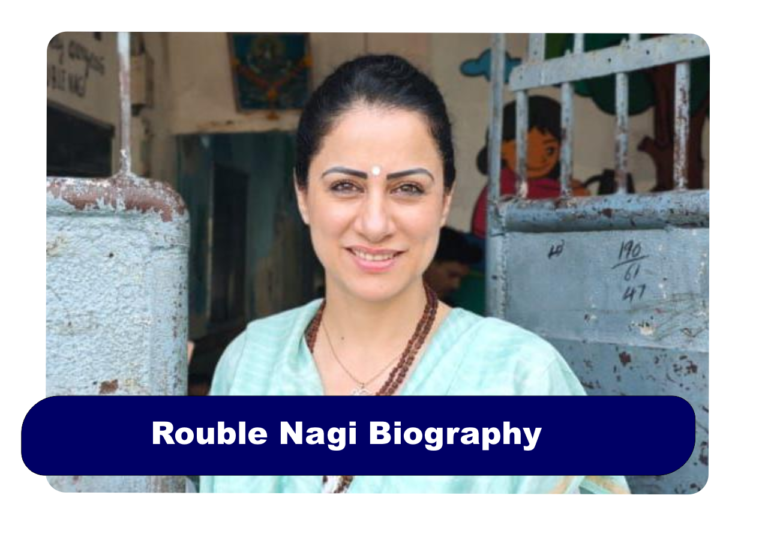
Rouble Nagi is a 45-year-old Indian artist and educator who won the $1M Global Teacher Prize 2026. Explore her art, Misaal Mumbai, and inspiring social work journey.
Rouble Nagi is one of India’s most remarkable creative forces — an artist, sculptor, educator, and social reformer whose work has touched the lives of millions. Born in Jammu & Kashmir and based in Mumbai, she has spent over two decades using art as a vehicle for change, transforming slum communities, educating underprivileged children, and empowering women across rural India. In February 2026, she made global headlines when she was awarded the prestigious $1 million Global Teacher Prize at the World Governments Summit in Dubai.
What makes Nagi’s story extraordinary is the seamlessness with which she moves between worlds — from international galleries and exhibitions to the dusty lanes of Mumbai’s slums. She is the only Indian artist known to work across 40+ mediums, and she has channelled that versatility not just into aesthetics but into activism. As she said on the international stage in Dubai: “This is not my honour — this is the honour of my country, India.”
Quick Facts About Rouble Nagi
| Detail | Information |
|---|---|
| Full name | Rouble Nagi |
| Date of birth | 8 July 1980 |
| Age (2026) | 45 years old |
| Birthplace | Jammu & Kashmir, India |
| Profession | Artist, sculptor, educator, social reformer, author |
| Spouse | Saahil (private) |
| Education | B.A. Political Science; Slade School of Fine Art, London |
| Foundations | Rouble Nagi Art Foundation; Rouble Nagi Design Studio |
| Famous for | Misaal Mumbai, Global Teacher Prize 2026, Rashtrapati Bhavan exhibition |
| Book | The Slum Queen (2022) |
Early Life and Family Background
Rouble Nagi was born on 8 July 1980 in Jammu & Kashmir, into a family with an army background. Growing up in one of India’s most culturally layered regions, she developed a sensitivity to community, service, and resilience from a young age. By the time she was four years old, her interest in art had already taken root — a curiosity that would eventually define the entire course of her life.
Her upbringing instilled in her a deep sense of social responsibility. The values of compassion and service that characterise her work are rooted, in part, in her faith and family environment. She grew up understanding that art was not a luxury — it was a language accessible to everyone, including those the world had left behind.
Education: From Political Science to Fine Art in London
Nagi pursued a Bachelor of Arts in Political Science before making a pivotal turn toward her true calling. She enrolled at the Slade School of Fine Art in London, one of the world’s most prestigious fine arts institutions, where she developed the technical breadth and conceptual depth that would define her practice. This unusual combination — political science and fine art — speaks directly to the nature of her work, which has always been as much about society as it is about aesthetics.
Her academic years abroad sharpened her understanding of art’s potential as a tool for social commentary and community transformation. It was a foundation she would put to extraordinary use on returning to India.
Artistic Career: Murals, Sculptures, and 150+ Exhibitions
Nagi returned to India and built a career that defies easy categorisation. She established the Rouble Nagi Design Studio and went on to create more than 800 murals, participating in over 150 exhibitions across India and internationally. She is the only Indian artist to work across 40+ mediums, ranging from sculpture and mosaic to installation and painting.
Some of her most recognised public art pieces include Journey Through the Ocean, a mosaic sculpture at Carter Road Promenade in Bandra, Mumbai; Pop Garden, a mixed media installation at Worli Seaface; and Tree of Life, a mosaic mural at Bandra Hill Road. Each piece reflects her philosophy that public art should be accessible, alive, and embedded in the fabric of everyday life.
In 2017, she became the first artist to be invited to exhibit at the Rashtrapati Bhavan Museum in New Delhi, with her work personally selected by the President of India for the museum’s permanent collection. She has also participated in international art camps, including events at the London Business School in 2006 and community art camps for children in Mumbai, Rajasthan, and Hyderabad.
Misaal Mumbai and Misaal India: Art as Social Infrastructure
The initiative that brought Nagi’s work to the widest audience is undoubtedly Misaal Mumbai — the first slum painting initiative of its kind in India. Launched following the Paint Dharavi project in 2018, Misaal Mumbai mobilised thousands of volunteers to paint and repair slum housing across the city, with the goal of transforming not just surfaces but mindsets.
To date, the initiative has painted and repaired more than 155,000 homes across 163 slums and villages throughout India, evolving into the broader Misaal India movement. The project uses colour and art as a bridge to communicate vital community messages — around children’s education, women’s empowerment, sanitation, hygiene, waste management, and youth employment. The walls fade; the message, as Nagi has said, is meant to last.
Alongside Misaal, her Rouble Nagi Art Foundation has established over 800 learning centres across India, many located within slum communities. These centres use art as an entry point for formal education, reaching children who might otherwise have no access to schooling.
The Global Teacher Prize 2026: A $1 Million Recognition
In February 2026, Rouble Nagi was honoured on stage at the World Governments Summit in Dubai, where she received the Global Teacher Prize — a $1 million award presented by the Varkey Foundation in collaboration with UNESCO. The prize, now in its tenth year, received over 100,000 applications and nominations globally, and recognises educators whose work transforms communities well beyond the walls of a classroom.
Nagi was recognised specifically for her work through Misaal India, her 800+ learning centres, and her broader model of art-led education that reaches India’s most marginalised communities. She is among the most high-profile Indians to receive the honour, and her win drew widespread attention both nationally and internationally.
Her immediate response on stage was characteristically selfless: she dedicated the recognition to India and announced plans to use the platform to open schools for underprivileged children in Jammu and Kashmir, and to establish vocational training centres to equip young Indians with practical, employable skills.
Author and Advocate: The Slum Queen
In 2022, Nagi published The Slum Queen, a book that documents her years of work in slums and villages across India. The title is both a reflection of how communities have come to regard her presence and a testament to where she believes real change happens — not in galleries, but on the ground. The book has been received as an honest, moving account of what community art can look like in practice, and what it demands of those who choose it as their life’s work.
Beyond writing, she continues to visit rural areas in Kashmir, providing skill training to women and creating awareness around village entrepreneurship. She is a member of the India Design Council (IDC), reflecting her recognised standing within India’s broader design and creative community.
Personal Life
Rouble Nagi is married to Saahil, who maintains a deliberately low public profile. He has been described as a steadying presence behind her demanding schedule, enabling her to commit fully to projects that often take her far from home for extended periods. The couple keeps their personal life private, and Nagi rarely discusses family matters in public forums.
Awards and Recognition
Nagi’s work has earned her recognition across both the art and social sectors. She received the Jijamata Award for Social Work and Art from the Government of India in 2013, as well as the GR8 Award for Best Women Artist of the Year in the same year. The Global Teacher Prize 2026 represents the pinnacle of her international recognition to date, placing her among the world’s most celebrated educator-changemakers.
Her paintings have been collected by corporations, celebrities, and the Government of India, and her work is held in museum collections including the Rashtrapati Bhavan Museum.
Wrapping Up
Rouble Nagi is proof that art and social change are not separate pursuits — they are the same pursuit, approached from different angles. Over two decades, she has built something that is simultaneously a creative practice, an educational network, a public health initiative, and a movement: all of it powered by a paintbrush and an unshakeable belief that beauty is not a privilege.
The Global Teacher Prize did not create her legacy; it simply made it visible to the world. With plans to expand her work into Jammu and Kashmir and deepen the Misaal India network, Rouble Nagi at 45 is, by any measure, still in the middle of her story.
People Also Ask
Who is Rouble Nagi?
Rouble Nagi is an Indian artist, sculptor, educator, and social reformer born on 8 July 1980 in Jammu & Kashmir. She is the founder of the Rouble Nagi Art Foundation and Misaal India, and in 2026 she won the Global Teacher Prize — a $1 million UNESCO-backed award — for her transformative work in education and community development.
What is Misaal Mumbai?
Misaal Mumbai is Rouble Nagi’s flagship social initiative, launched in 2018 following the Paint Dharavi project. It uses art and community volunteers to paint and repair homes in slums, using the process to spread awareness about education, hygiene, women’s empowerment, and sanitation. It has since expanded nationally as Misaal India, covering over 163 slums and villages.
What did Rouble Nagi win the Global Teacher Prize for?
She won the 2026 Global Teacher Prize — a $1 million award by the Varkey Foundation in collaboration with UNESCO — for creating over 800 learning centres in underserved communities across India and pioneering art-led education through the Misaal India movement.
What is Rouble Nagi’s book about?
Her 2022 book The Slum Queen documents her years of work in India’s slums and villages, offering a firsthand account of using art as a tool for education, social reform, and community transformation.
Where did Rouble Nagi study art?
She studied fine art at the Slade School of Fine Art in London, one of the world’s leading fine arts institutions, after completing a Bachelor of Arts in Political Science in India.