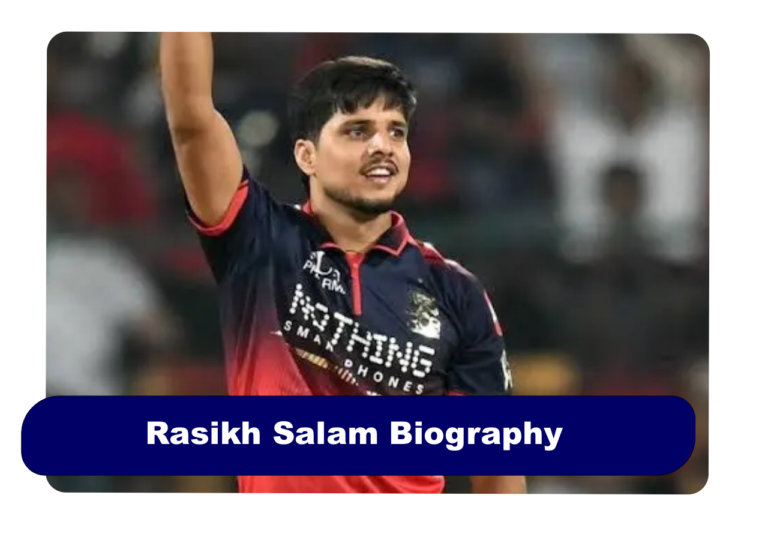
Rasikh Salam is an Indian fast bowler born April 5, 2000, in Kulgam, J&K. Now at RCB in IPL 2026, his journey from a two-year ban to IPL stardom is one of cricket’s great comeback stories.
Some cricket careers are defined by centuries and records. Rasikh Salam Dar’s is defined by something rarer — the refusal to disappear. The 26-year-old right-arm fast bowler from Kulgam, Jammu and Kashmir, has navigated a two-year ban, a stress fracture, administrative setbacks, and years of waiting to become one of IPL 2026’s most talked-about young pacers. Now representing Royal Challengers Bengaluru, he is finally living up to the promise that had people excited since he was a teenager.
What makes his story stand out is not just the talent — it is the trail of hardships behind it. Spotted at a trial by former India all-rounder Irfan Pathan when he was barely 17, Rasikh went from almost quitting cricket to becoming the youngest player to debut for Mumbai Indians. The road from there to RCB was anything but straight.
Quick Facts About Rasikh Salam
| Detail | Information |
|---|---|
| Full Name | Rasikh Salam Dar |
| Date of Birth | April 5, 2000 |
| Age | 26 (as of 2026) |
| Birthplace | Kulgam, Jammu & Kashmir, India |
| Role | Bowler (Right-arm Fast-Medium) |
| Batting Style | Right-handed |
| IPL Team (2026) | Royal Challengers Bengaluru (RCB) |
| IPL Price (2026) | ₹6 crore |
| Domestic Teams | J&K (2018–2025), Baroda (2025–present) |
| Previous IPL Teams | Mumbai Indians, Kolkata Knight Riders, Delhi Capitals |
| Net Worth | ₹8–9 crore (est. 2026) |
| Father | Abdul Salam (school teacher) |
| Famous For | Death-overs bowling, comeback from age-fraud ban |
Early Life in the Kashmir Valley
Rasikh Salam Dar was born on April 5, 2000, in Kulgam, a district in South Kashmir. He grew up in a modest household — his father, Abdul Salam, worked as a school teacher and supported the family with limited means. Despite those constraints, Abdul Salam encouraged his son’s passion for cricket, a belief in the boy’s talent that would prove well-placed.
Kulgam is not exactly a nursery for IPL cricketers. The region’s cricket ecosystem is thin, and most young players there never make it beyond district-level tournaments. Rasikh spent his early years at local trials, often getting overlooked. At one such trial at the Sher-i-Kashmir Stadium, around 70 young fast bowlers had gathered hoping to be noticed. Rasikh was among them, expecting the same result as every other year.
It was Irfan Pathan — then serving as mentor for Jammu & Kashmir’s Ranji Trophy team — who changed everything. Pathan recalled that Rasikh bowled just two or three deliveries: a slower ball, then a quick one. When Pathan asked him to wait back, Rasikh began to leave, assuming he had been rejected as usual. That moment of near-miss has since become one of Indian cricket’s favourite anecdotes.
Domestic Debut and the Road to the IPL
Rasikh made his domestic debut for Jammu & Kashmir in the 2018–19 season, appearing across the Vijay Hazare Trophy, Syed Mushtaq Ali Trophy, and the Ranji Trophy. His pace and movement caught enough attention that, at the age of 17, he was shortlisted for the 2019 IPL auction — one of only four players from Jammu & Kashmir to make the list.
Mumbai Indians picked him up at his base price of ₹20 lakh. On March 24, 2019, he made his IPL debut against Delhi Capitals at the Wankhede Stadium, becoming the youngest player ever to represent Mumbai Indians at just 17 years and 353 days. The debut was tough — he conceded 42 runs in four overs without a wicket — but the raw materials were obvious to those watching closely.
Following his strong domestic appearances, he was also called up to the India Under-19 squad, where his future seemed bright. Then came the setback that threatened to end everything.
The Two-Year Ban and a Test of Character
In June 2019, the BCCI handed Rasikh a two-year ban after discovering a discrepancy in his birth certificate — a situation described as age fraud. The punishment came just as he was gaining momentum and ruled him out of the 2020 Under-19 World Cup, an opportunity he had been working toward for years.
The ban was a crossroads. He could have drifted away from the game entirely. Instead, Mumbai Indians — with whom he had only played one match — took an unusual step. Despite not being contractually obligated to do so, the franchise allowed him to train at their private facility in Mumbai under Rahul Sanghvi, a former India spinner and MI’s talent scout. He was assigned a full-time trainer, a sports psychologist, and a physio.
But the isolation of that period weighed on him. It was Irfan Pathan, his original discoverer, who sensed the mental strain and stepped in personally. Pathan provided the mentorship and motivation that kept Rasikh grounded and connected to the game during his two hardest years.
Comeback, Injuries, and the Long Rebuild
When the ban ended, Rasikh’s return was far from seamless. He was picked up by Kolkata Knight Riders in the 2022 IPL auction but managed just two games before a stress fracture in his lower back sidelined him for the rest of the season. It was yet another test of resilience for a player who had already endured far more than most.
He returned to competitive cricket during the 2023–24 domestic season and earned his way back into IPL calculations through consistent performances in the Syed Mushtaq Ali Trophy and the Vijay Hazare Trophy. Delhi Capitals took notice and signed him for IPL 2024, where he delivered his best IPL showing to date — nine wickets in eight matches, including a three-wicket performance against Mumbai Indians, the very franchise that had backed him through his darkest years.
That 2024 campaign brought recognition beyond the IPL. He was selected for India’s squad at the 2024 Emerging T20 Asia Cup in Oman, where he was the standout bowler despite India’s semifinal exit. The performance confirmed what those close to him had long believed: Rasikh Salam was not just a project — he was ready.
IPL 2025 and the RCB Move
Ahead of the 2025 IPL auction, Delhi Capitals released Rasikh. Rather than a setback, his performances had created genuine demand. He sparked a bidding war at the auction and was eventually signed by Royal Challengers Bengaluru for ₹6 crore — a massive leap from the ₹20 lakh he had fetched three times before. RCB, fresh off their 2024 IPL title, viewed him as a long-term investment.
He could not break into the playing XI during RCB’s title-winning 2025 season, but the franchise remained patient. Ahead of the 2025–26 domestic season, Rasikh also made the decision to move from Jammu & Kashmir to Baroda — a transfer aimed at finding more consistent game time and a stronger support structure. He performed well for Baroda in the Ranji Trophy, Vijay Hazare Trophy, and Syed Mushtaq Ali Trophy, arriving at IPL 2026 in the best shape of his career.
IPL 2026: Breaking Through at RCB
In IPL 2026, Rasikh has finally delivered on the promise that has followed him for nearly a decade. Stepping up in the absence of injured teammate Yash Dayal, he has become a key part of RCB’s bowling attack alongside veterans Bhuvneshwar Kumar, Krunal Pandya, and Josh Hazlewood.
In a standout performance against Lucknow Super Giants in April 2026, he dismissed Ayush Badoni, Mukul Choudhary, and Avesh Khan to help bowl the opposition out for 146. His numbers through the early stages of the season reflect the control and confidence of a bowler who has finally found his footing — five wickets in two matches at an average of 9.4 and an economy of 6.88.
His primary weapon is the death-over slower ball and knuckle delivery, which batters find difficult to read. He can generate pace consistently in the 135–140 km/h range, swing the new ball, and operate across the middle overs when needed. The complete package, refined slowly and at great personal cost.
Net Worth and Earnings
Rasikh’s estimated net worth stands at ₹8–9 crore as of 2026, with the majority coming from his ₹6 crore IPL contract with RCB. Earlier in his career, he earned ₹20 lakh per IPL season across three different franchises — meaning his 2025 auction result represented a thirty-fold increase in IPL valuation. His earnings also include domestic cricket fees and BCCI match payments at the state and India A level.
Wrapping Up
Rasikh Salam’s journey from an anonymous young pacer at a Kashmir trial ground to a ₹6 crore IPL bowler for the defending champions is one of the more compelling stories in recent Indian cricket. It involved a two-year ban, serious injury, years in the wilderness, and a franchise investing in him with no obligation to do so.
The version of Rasikh Salam playing in IPL 2026 has been shaped by all of that. The raw pace that caught Irfan Pathan’s eye is still there. What has been added is patience, variation, and the mental strength of someone who has already survived the game trying to close its door on him more than once.
At 26, with his best cricket still ahead of him, a push for a senior India cap feels less like ambition and more like the next logical step.
People Also Ask
Who is Rasikh Salam?
Rasikh Salam Dar is a 26-year-old Indian fast bowler from Kulgam, Jammu & Kashmir. He plays for Royal Challengers Bengaluru in the IPL and Baroda in domestic cricket, and is known for his death-overs bowling and knuckle ball delivery.
Why was Rasikh Salam banned?
The BCCI handed Rasikh a two-year ban in June 2019 after a discrepancy was found in his birth certificate. The ban ruled him out of the 2020 Under-19 World Cup and effectively paused his career at a critical stage.
Which IPL team does Rasikh Salam play for in 2026?
Rasikh Salam plays for Royal Challengers Bengaluru (RCB) in IPL 2026. He was signed for ₹6 crore at the 2025 IPL auction after a strong showing for Delhi Capitals in the 2024 season.
Who discovered Rasikh Salam?
Former India all-rounder Irfan Pathan spotted Rasikh at a trial in Srinagar when he was mentoring Jammu & Kashmir’s Ranji Trophy side in 2018. Pathan was instrumental in getting him into Mumbai Indians’ radar and later continued to mentor him through his two-year ban.
What is Rasikh Salam’s bowling speed?
Rasikh Salam bowls right-arm fast-medium at a consistent pace of 135–140 km/h. He is particularly effective with a slower ball and knuckle delivery in the death overs.