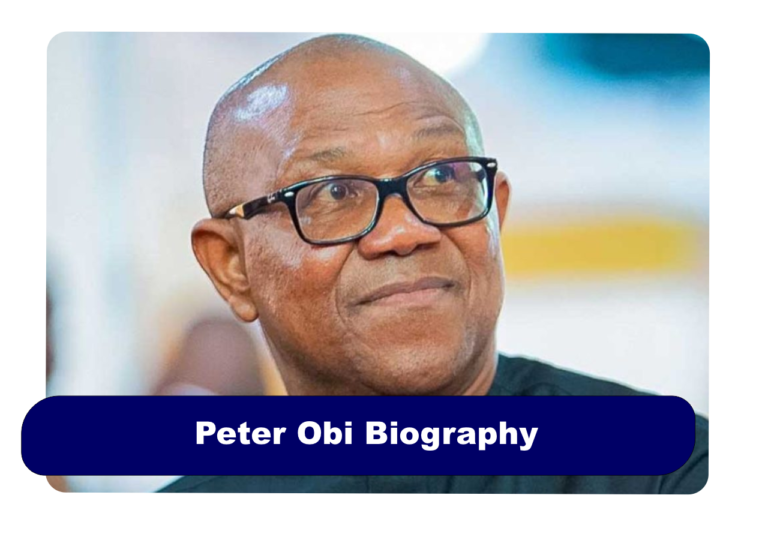
Peter Obi is a Nigerian politician, businessman, and 2023 Labour Party presidential candidate. Born July 19, 1961, he’s 64, married to Margaret Usen, with a net worth estimated at $10–$58 million.
Peter Gregory Obi is one of the most consequential political figures in modern Nigerian history. A businessman turned governor turned presidential candidate, he has spent two decades challenging the conventions of Nigerian politics — not through grand speeches alone, but through the uncomfortable example of actually doing things differently. His nickname, “Okwute,” is Igbo for “Rock,” and it has aged well.
He rose to national prominence as the Labour Party’s presidential candidate in the 2023 general election, igniting a grassroots movement — the “Obidient” movement — that drew millions of young Nigerians into political participation for the first time. Though he lost that race, the reverberations of his campaign continue to reshape how Nigerians think about accountability, fiscal governance, and third-party politics. As of 2026, with the 2027 election firmly in his sights, Obi remains as relevant as ever.
Quick Facts About Peter Obi
| Detail | Information |
|---|---|
| Full Name | Peter Gregory Obi |
| Date of Birth | July 19, 1961 |
| Age | 64 (as of 2026) |
| Birthplace | Onitsha, Anambra State, Nigeria |
| Hometown | Agulu, Anaocha LGA, Anambra State |
| Profession | Politician, Businessman |
| Religion | Catholic |
| Net Worth | $10–$58 million (est. 2025) |
| Spouse | Margaret Brownson Usen (m. 1992) |
| Children | Gabriella Nwamaka Frances Obi; Gregory Peter Oseloka Obi |
| Education | Christ the King College, Onitsha; B.A. Philosophy, University of Nigeria, Nsukka (1984) |
| Current Party | Nigeria Democratic Congress (NDC) |
| Famous For | Governor of Anambra State (2006–2014); 2023 Labour Party presidential candidate |
Early Life and Family Background
Peter Obi was born on July 19, 1961, in Onitsha — one of southeastern Nigeria’s most commercially active cities, and a place that would leave a permanent imprint on how he thought about money, trade, and value. He is the fourth son of Josphat Obi and Agnes Obi, a devout Catholic family whose parents ran a popular supermarket in Onitsha. Growing up in that environment gave him an early, practical education in entrepreneurship and financial discipline.
He hails originally from Agulu in Anaocha Local Government Area of Anambra State. His parents’ Catholicism was not merely nominal — it anchored the household in a set of values around integrity, frugality, and service that would later define Obi’s public persona. Among friends and associates, he was known as “Okwute,” a nickname that means “Rock” in Igbo, a name that seemed to track him everywhere he went.
He grew up alongside several siblings, including Ndibe Obi, who later managed some of his business ventures, and Martina Obi, his younger sister. The family’s roots in trade meant that Peter was as comfortable discussing balance sheets as he was discussing policy — a combination that would serve him well in both boardrooms and governance.
Education: Philosophy, Law, and a Hunger for Knowledge
Obi attended the prestigious Christ the King College in Onitsha for his secondary education — a school with a strong academic tradition in southeastern Nigeria. He then enrolled at the University of Nigeria, Nsukka in 1980, graduating in 1984 with a Bachelor of Arts degree in Philosophy. It is a degree that may seem unusual for a politician and businessman, but it gave him the analytical rigor and ethical frameworks that became hallmarks of his public life.
His appetite for learning did not stop there. Over the years, Obi pursued executive education and professional development at several institutions internationally, building a broader foundation for his business and governance roles. He is notably a member of the Order of the Coif — a distinction typically associated with high academic achievement in law — though his primary degree remained in the humanities. He is also a Fellow of the Institute of Chartered Accountants of Nigeria, which speaks to the depth of his financial training outside the classroom.
Business Career: From Trader to Banking Boardroom
Before politics, Peter Obi built a genuine business career rooted in the trading and import sector — an extension, in many ways, of his family’s commercial heritage in Onitsha. He moved from trading into the corporate sector, serving on the boards of several significant Nigerian companies and financial institutions.
Among his most notable positions, Obi served as the youngest-ever Chairman of Fidelity Bank Plc — a milestone that signaled both his financial acumen and his ability to earn institutional trust at a relatively young age. He also had board-level roles at companies including Next International and various other private enterprises spanning retail, insurance, and finance.
This business background was more than a biographical footnote. It became central to his political identity — the argument being that a man who understood how money actually worked, who had run real organizations and managed real balance sheets, would govern differently from career politicians. When he talked about fiscal discipline, he was drawing on personal experience, not theory.
Governor of Anambra State: The Record That Built His Reputation
Peter Obi’s political career began when he was elected Governor of Anambra State under the All Progressives Grand Alliance (APGA) in 2006. The start was turbulent — he served from March to November 2006 before being impeached by the state legislature. His deputy, Virginia Etiaba, became the first female governor in Nigeria’s history during the interim period. The Supreme Court reinstated Obi in February 2007, and he served until May 2007, before being removed again as his predecessor’s tenure was restored. He was re-elected in 2010 and served a full second term until March 2014.
The record he compiled across those years became the foundation of his national reputation. His administration paid off Anambra’s inherited domestic debt, cleared backlogs of unpaid salaries, and ran a demonstrably lean cost of governance. He returned schools to their original missionary owners, invested heavily in education infrastructure and teacher training, and oversaw a period in which Anambra consistently ranked first in national external examinations.
Perhaps most remarkably, he left office in 2014 with substantial funds still in the state treasury — a Sub-Sovereign Wealth savings program that stood in almost comical contrast to the way Nigerian governors typically exit power. Over 500 schools were rehabilitated during his tenure, literacy rates improved significantly, and hospitals were upgraded in partnership with international health organizations.
The Road to the 2023 Presidential Election and the Obidient Movement
After leaving Anambra’s governorship, Obi joined the Peoples Democratic Party (PDP) and was selected as the vice-presidential running mate to Atiku Abubakar in the 2019 presidential election. The Atiku-Obi ticket lost to incumbent President Muhammadu Buhari and the APC, but the experience raised Obi’s national profile considerably and introduced him to a broader political audience.
In 2022, he made the defining move of his political career. He resigned from the PDP and defected to the Labour Party in May 2022, citing systemic corruption within the larger parties. His presidential campaign rapidly evolved into something far larger than a typical candidacy. The “Obidient” movement — a name coined by his supporters — became a genuine grassroots phenomenon, driven overwhelmingly by young Nigerians and the diaspora who organized their own rallies, ran their own social media campaigns, and flooded the streets without being paid to do so.
He selected Senator Yusuf Datti Baba-Ahmed as his running mate. The results were announced on March 1, 2023: Bola Ahmed Tinubu of the APC was declared president-elect with approximately 8.79 million votes, while Obi received 6.1 million — finishing third but winning in both Lagos and Abuja, which were remarkable symbolic victories. He challenged the result in court, but the tribunal and subsequent appeals upheld Tinubu’s win.
Personal Life: Marriage and Family
Peter Obi married Margaret Brownson Usen in 1992. The couple has two children: a daughter, Gabriella Nwamaka Frances Obi, and a son, Gregory Peter Oseloka Obi. Obi has consistently kept his family out of political spotlights, and Margaret has maintained a notably low public profile. Rumors about the state of their marriage circulated in 2017, but Margaret publicly rejected these reports as false.
Obi is a devout Catholic and has spoken openly about faith’s role in shaping his values around service and integrity. His insistence on separating personal benefit from public office — including reportedly advising his wife to forgo the traditional “Office of First Lady” trappings during his governorship — speaks to a personal discipline that has become part of his political brand.
Net Worth and Financial Profile
Estimates of Peter Obi’s net worth vary widely, ranging from approximately $10 million on the conservative end to around $58 million on higher assessments, reflecting the difficulty of evaluating assets in the Nigerian private sector. What is less disputed is that he is considerably less wealthy than most of Nigeria’s major political figures — a fact he has leaned into as a political asset rather than a liability.
His wealth comes primarily from his pre-politics business career in banking, trading, and retail. During his tenure as governor, he was known for using his own vehicles and traveling economy class on domestic flights — habits that made him an outlier in a political culture where public office is routinely treated as a vehicle for personal enrichment.
Political Moves Post-2023 and the 2027 Horizon
After the 2023 defeat, Obi formally defected to the African Democratic Congress (ADC) in December 2025, joining a broader opposition coalition that included Atiku Abubakar and former Kaduna Governor Nasir El-Rufai. The coalition was assembled to challenge President Tinubu in the 2027 general election.
However, the ADC arrangement proved unstable. By April 2026, Obi and former Kano Governor Rabiu Kwankwaso had moved to the Nigeria Democratic Congress (NDC), with reports indicating they would contest 2027 on a joint ticket — Obi as presidential candidate, Kwankwaso as his running mate. At his February 2026 declaration in Uyo, Akwa Ibom State, Obi reaffirmed his intent to run, declaring with characteristic directness: “I will contest the coming election even if it is held in their bedroom.”
Final Thoughts
Peter Obi’s significance in Nigerian political life is not reducible to any single election result. He represents something that is still rare in Nigerian politics: a politician whose reputation was built on what he actually did with public resources, rather than on charisma, patronage networks, or ethnic arithmetic alone.
His frequent party changes have attracted legitimate criticism, and questions persist about whether the Obidient movement can be converted into durable electoral infrastructure. But the record he left in Anambra State, and the conversation his 2023 candidacy forced, have shifted the terms of political debate in Nigeria in ways that will outlast any single campaign.
At 64, with the 2027 election approaching, Peter Obi remains one of Nigeria’s most watched political figures — a man still defined, above all, by the belief that good governance is not a miracle but a choice.
People Also Ask
What is Peter Obi best known for?
Peter Obi is best known for his tenure as Governor of Anambra State from 2006 to 2014, where he was widely praised for fiscal discipline and education reform, and for his 2023 presidential run under the Labour Party, which ignited the youth-driven “Obidient” movement.
What is the Obidient movement?
The Obidient movement was a grassroots political phenomenon that emerged during Obi’s 2023 presidential campaign. Driven largely by young Nigerians and diaspora voters, it became one of the most significant third-party political movements in Nigerian history, mobilizing supporters through social media and street marches without centralized funding.
Which party does Peter Obi belong to in 2026?
As of 2026, Peter Obi is a member of the Nigeria Democratic Congress (NDC), having previously moved through APGA, PDP, Labour Party, and ADC. He is preparing to contest the 2027 presidential election on the NDC platform, reportedly with Rabiu Kwankwaso as his running mate.
Is Peter Obi married?
Yes. Peter Obi has been married to Margaret Brownson Usen since 1992. The couple has two children — a daughter, Gabriella, and a son, Gregory. Obi keeps his family life private and his wife has maintained a deliberately low public profile.
What is Peter Obi’s net worth?
Estimates of his net worth range from approximately $10 million to $58 million, depending on the source and methodology. His wealth derives primarily from his pre-politics career in banking, trading, and retail. He is notably less wealthy than most prominent Nigerian politicians, which has become a distinctive part of his public identity.