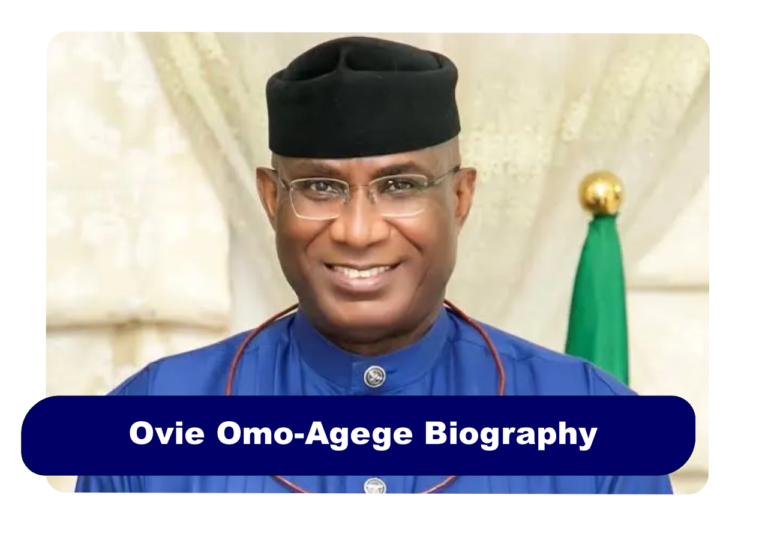
Ovie Omo-Agege is a Nigerian lawyer and politician, former Deputy Senate President (2019–2023). Born August 3, 1963, he’s 62, married to Rosemary, with five children.
Ovie Omo-Agege is one of the most recognizable political figures in Nigeria’s South-South geopolitical zone. A lawyer turned senator, he served as the Deputy President of the Nigerian Senate from 2019 to 2023 — the highest position ever attained by a senator from Delta State. His career spans decades of legal practice, executive appointments, and legislative leadership, making him a defining voice in Delta State’s political landscape.
His story, however, is not without turbulence. From a Senate mace controversy that made national headlines to a hard-fought gubernatorial battle in 2023, Omo-Agege has navigated the full spectrum of Nigerian political life. Most recently, in May 2026, he resigned from the ruling All Progressives Congress after losing the Delta Central senatorial primary — a move that has set the stage for a potentially decisive chapter ahead of the 2027 elections.
Quick Facts About Ovie Omo-Agege
| Detail | Information |
|---|---|
| Full Name | Obarisi Ovie Omo-Agege |
| Date of Birth | August 3, 1963 |
| Age | 62 (as of 2026) |
| Origin | Orogun, Ughelli North LGA, Delta State, Nigeria |
| Ethnicity | Urhobo |
| Profession | Politician, Lawyer, Businessman |
| Political Party | Resigned from APC, May 2026 |
| Spouse | Rosemary Omo-Agege |
| Children | Five |
| Education | LL.B, University of Benin (1985); LL.M, Tulane University Law School (2002) |
| Notable Roles | Deputy Senate President (2019–2023); Senator, Delta Central (2015–2023) |
| National Honour | Commander of the Order of the Federal Republic (CFR) |
| Business | Chairman/CEO, TechSprings Ltd |
Early Life and Family Background
Obarisi Ovie Omo-Agege was born on August 3, 1963, in Orogun, in what was then the Mid-Western Region of Nigeria — today part of Ughelli North Local Government Area in Delta State. He hails from the Orogun clan of the Urhobo ethnic group, one of the largest in the Niger Delta. His roots in that community have remained a central pillar of his political identity throughout his career.
He was born into a family with a distinguished legal tradition. His father, Justice James Omo-Agege, served as a Chief Justice of Delta State — a lineage that almost certainly shaped young Ovie’s early attraction to the law. His mother, Mrs. Francesca Okwendo, comes from the Wanogho Royal Family, also of Orogun, giving him strong royal and institutional connections within the Urhobo community.
For his secondary education, Omo-Agege attended St. George’s Grammar School, Obinomba, near Obiaruku in Delta State. The institution, known for producing several prominent Nigerians, provided the academic foundation that would carry him into university and, eventually, international legal study.
Education: From Benin to Tulane
Omo-Agege pursued his legal education at the University of Benin, Benin City, graduating with an LL.B in 1985. He was subsequently called to the Nigerian Bar in 1986, completing his National Youth Service Corps (NYSC) the following year in 1987. From the outset, his academic record signaled serious intent in the legal profession.
Decades later, he returned to formal education and earned a Master of Laws (LL.M) degree from Tulane University Law School in New Orleans, Louisiana — one of the oldest and most respected law schools in the United States. This dual grounding — in Nigerian and American legal traditions — informed both his private legal practice and his later legislative work, particularly around complex commercial and constitutional matters.
Legal Career and Early Business Ventures
After completing his NYSC, Omo-Agege moved to Lagos and began his legal career at Pat Okupa & Co. The experience of working at a commercial law firm in Nigeria’s business capital gave him practical exposure to corporate and litigation work. In 1989, he struck out on his own, establishing Agege & Co, a private practice concentrating on commercial litigation and corporate banking matters.
In 1990, he relocated to Los Angeles, California, where he worked as a foreign associate at an American law firm, advising foreign clients on Nigerian law. This international posting further expanded his professional network and deepened his understanding of cross-border business. It was a career trajectory that positioned him well for the intersection of law, business, and politics that would define his later years.
He also built a business presence in the oil and gas sector. He is the Chairman and CEO of TechSprings Ltd, a dredging and oil services company based in Port Harcourt, Rivers State — a business interest that reflects the economic realities of the Niger Delta region where his political base is rooted.
Rise Through Delta State Politics
Omo-Agege’s political journey began with a loss. He contested the Peoples Democratic Party primaries for a Delta State House of Representatives seat and was defeated before the race even reached the general election. Rather than retreat, he stayed close to the political machinery of the state.
In 2003, Governor James Ibori appointed him as his first Executive Assistant, tasking him with policy formulation, monitoring of executive council decisions, and coordinating the governor’s relationships with the PDP national secretariat and the presidency. It was a consequential role that placed him at the center of Delta State’s political operations. He was later appointed Commissioner for Special Duties under the same administration.
He also made an early bid for the governorship of Delta State under the PDP, but lost at the party primaries to Governor Emmanuel Uduaghan. Undeterred, Governor Ibori appointed him Secretary to the State Government (SSG) in January 2007 — one of the most powerful administrative positions in any Nigerian state government. In that role, he restructured the Office of Project Monitors to improve oversight of government contracts and infrastructure delivery, an initiative that reportedly outlasted his time in office.
Senate Career: Two Terms and a Historic Elevation
Omo-Agege entered the Senate in 2015, not under the PDP or APC, but under the Labour Party — making him the only senator elected on the Labour Party platform in that cycle. He won the Delta Central Senatorial District seat on March 28, 2015, and took his seat in the 8th Senate. In March 2017, he defected from Labour Party to the All Progressives Congress, aligning himself with the ruling party under President Muhammadu Buhari.
He was re-elected in the 2019 general elections under the APC banner, returning to the Senate for a second term. On June 11, 2019, he was elected Deputy President of the 9th Senate, defeating incumbent Ike Ekweremadu with 68 votes to 37. The margin was decisive, and the moment historic — Omo-Agege became the first senator from Delta State, and the first from Delta Central, to hold the second-highest position in the National Assembly.
During his tenure as Deputy Senate President, he was recognized as the APC leader in the South-South geopolitical zone. He championed legislative priorities including the passage of the Federal Polytechnic Orogun Establishment Bill in February 2021, and brought federal attention to infrastructure needs in Delta Central, including solar-powered street lighting and educational facility upgrades in communities across his senatorial district. In October 2022, he was conferred with the national honour of Commander of the Order of the Federal Republic (CFR) by President Buhari.
The 2023 Gubernatorial Race
In April 2022, Omo-Agege formally declared his candidacy for the governorship of Delta State under the APC, resigning his Senate seat to contest the election. He ran on a platform of economic revitalization and inclusive governance, positioning himself as the candidate who could break the PDP’s long-running dominance in Delta State.
He secured the APC governorship ticket following competitive internal primaries, though the process was not without internal controversy — rival APC figures including Festus Keyamo and Great Ogboru had accused him of hijacking the party machinery to guarantee his nomination. Omo-Agege’s faction was ultimately recognized by the national party as legitimate.
In the March 2023 election, he secured over 200,000 votes, mounting the most credible APC challenge to the PDP in Delta State in years. However, he lost to PDP candidate Sheriff Oborevwori. The defeat was significant — supporters have argued that the mandate was unlawfully taken from him, and those sentiments have continued to shape his political positioning heading into 2027.
Personal Life
Omo-Agege is married to Rosemary Omo-Agege, and the couple have five children together. He has been bestowed with several traditional titles in recognition of his standing in the Urhobo community, including the Obarisi of Ughelli, the Obarisi of Orogun, and the Ugo of Mosogar — titles that reflect both his royal connections and his stature as a community leader.
He has kept his family life largely out of public view, in contrast to the very public nature of his political career. Rosemary Omo-Agege has occasionally appeared at state and ceremonial functions but has not sought a public profile of her own.
The Senate Mace Controversy
No account of Ovie Omo-Agege’s career would be complete without addressing the incident that made him internationally notorious. In April 2018, he was accused of coordinating an intrusion into the Senate chambers by masked men who removed the Senate Mace — the symbol of the Senate’s legislative authority — during a plenary session. The incident was widely condemned as an assault on Nigeria’s democratic institutions.
The disruption occurred in the context of a legal dispute: Omo-Agege had been suspended from the Senate following his public criticism of the Electoral Act amendment process. The mace removal was seen by many as an attempt to disrupt the quorum and prevent further legislative proceedings. He denied personal involvement in organizing the intrusion, but the episode remained a defining controversy of his political career.
APC Resignation and What Comes Next
On May 22, 2026, Ovie Omo-Agege resigned his membership of the APC, effective immediately. The resignation came after he lost the Delta Central APC senatorial primary to incumbent Senator Ede Dafinone. In a letter addressed to the APC ward chairman in Orogun Ward 2, Ughelli North Local Government Area, he stated plainly that he would not remain in a party where he could no longer advance the interests of Delta Central, Delta State, and Nigeria.
The resignation is widely expected to trigger significant political realignment in Delta State ahead of the 2027 general elections. Some allies have already called on him to contest the 2027 Delta State governorship, with supporters claiming he commands an organic voter base of over 240,000 across the state. As of the time of writing, Omo-Agege has not announced which party he will join next, but the political signals point toward a gubernatorial ambition that remains very much alive.
Final Thoughts
Ovie Omo-Agege’s career is a study in persistence. He has lost primaries, lost a governorship race, been at the center of a national scandal, and — most recently — lost a Senate ticket in the party he helped build in Delta State. Yet at 62, he has not stepped back from the arena.
His legacy in the Senate is real: two terms, a historic elevation to Deputy Senate President, and legislative interventions that brought tangible infrastructure and institutions to Delta Central. His story also reflects the broader tensions of Nigerian federalism, ethnic politics, and the volatility of party loyalty in a system where alliances shift quickly.
Whatever political vehicle he chooses ahead of 2027, Omo-Agege remains one of the most consequential figures in Delta State politics — a man whose next move is already being watched closely across the Niger Delta and beyond.
People Also Ask
Who is Ovie Omo-Agege?
Ovie Omo-Agege is a Nigerian lawyer and politician from Orogun, Delta State. He served as Deputy President of the Nigerian Senate from 2019 to 2023 and was the APC’s gubernatorial candidate for Delta State in 2023. He resigned from the APC in May 2026 after losing a senatorial primary.
What is Ovie Omo-Agege’s educational background?
He holds an LL.B from the University of Benin (1985) and an LL.M from Tulane University Law School in New Orleans. He was called to the Nigerian Bar in 1986 and has practiced law in both Nigeria and the United States.
Why did Omo-Agege resign from the APC?
He resigned on May 22, 2026, following his defeat in the Delta Central APC senatorial primary to incumbent Senator Ede Dafinone. He cited the inability to advance the interests of his constituents within the party as the reason for his departure.
What was the Senate Mace incident?
In April 2018, masked individuals invaded the Nigerian Senate chambers and removed the Senate Mace during a plenary session. Omo-Agege was accused of orchestrating the intrusion, which occurred while he was under a Senate suspension. He denied personally directing the act, but the controversy followed him throughout his career.
Is Ovie Omo-Agege running for governor in 2027?
As of May 2026, Omo-Agege has not formally declared a 2027 governorship bid. However, following his APC resignation, key allies have publicly urged him to contest the Delta State governorship, citing his reported grassroots base of over 240,000 voters across the state.