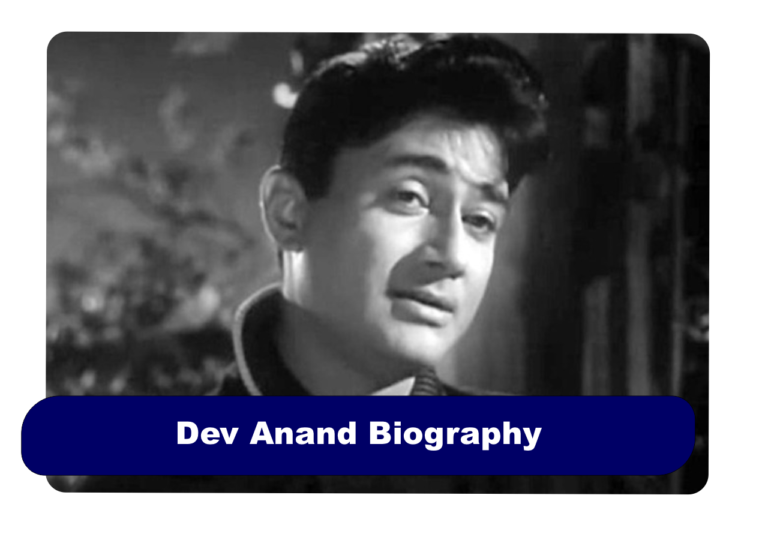
Dev Anand (1923–2011) was Bollywood’s Evergreen Hero. Known for Guide, Jewel Thief & Navketan Films. Explore his life, wife Kalpana Kartik, awards, and enduring legacy.
Dharamdev Pishorimal Anand — the world knew him simply as Dev Anand — was the face of a dream that a newly independent India was still learning to dream. For over six decades, he was the urbane, charming, restlessly optimistic hero at the heart of Hindi cinema: collar up, scarf flying, nodding mid-dialogue with a grin that suggested he knew something the rest of the room didn’t.
He was not merely an actor. He was a producer who built one of Bollywood’s most important studios, a director who launched careers, and a man who kept showing up — script in hand, eyes bright — well into his eighties. His nickname, the Evergreen Hero, was not given out of affection alone. He earned it with every frame.
Quick Facts About Dev Anand
| Detail | Information |
|---|---|
| Full Name | Dharamdev Pishorimal Anand |
| Born | September 26, 1923 |
| Birthplace | Shakargarh, Punjab, British India (now Pakistan) |
| Died | December 3, 2011 (aged 88) |
| Death Place | London, England |
| Cause of Death | Cardiac arrest |
| Profession | Actor, Producer, Director, Writer |
| Active Years | 1946–2011 |
| Production House | Navketan Films (est. 1949) |
| Wife | Kalpana Kartik (m. 1954; until his death) |
| Children | Suneil Anand (son), Devina Anand (daughter) |
| Awards | Padma Bhushan (2001), Dadasaheb Phalke Award (2002), Filmfare Lifetime Achievement (1993) |
| Net Worth (at death) | Est. ~$50 million |
| Nickname | Evergreen Hero |
Early Life: Punjab, Partition, and a Journey to Bombay
Dev Anand was born on September 26, 1923, in Shakargarh — a town in the Punjab district of undivided British India, now part of Pakistan. His father, Pishori Lal Anand, was a well-regarded advocate. The household was large and bookish, with four siblings: brothers Chetan Anand, Vijay Anand, and Manmohan Anand, and a sister, Sheel Kanta Kapur — who would later become the mother of celebrated filmmaker Shekhar Kapur.
He attended Sacred Heart School in Dalhousie before moving to Government College Lahore, where he graduated in English Literature. His years at Lahore College planted two seeds that would define his future: a love of language and an early fascination with theatre. When Partition arrived in 1947, the Anand family — like millions of Punjabi families — was forced to leave everything behind and cross into India.
Before Partition and before films, Dev Anand had a brief, unglamorous stint as a clerk in the Military Censor’s office in Bombay for a salary of Rs 165 a month. It was enough to eat, not enough to thrive — but Bombay’s film industry was visible from where he sat, and he was already determined to be part of it. His idol at the time was Ashok Kumar, whose films Achhut Kanya and Kismet he had watched, rewatched, and studied.
Entry into Films and the Navketan Era
His film debut came in 1946 with Hum Ek Hain, a modest production that gave him his first screen credit and his first fee — Rs 365 per film, which he used to buy a second-hand Hillman Minx. The real turning point came in 1948 when Ashok Kumar — the very actor he had idolized — personally chose him to lead Ziddi. The film was a commercial success and established Dev Anand as a name to watch.
In 1949, alongside his elder brother Chetan Anand, he co-founded Navketan Films — a production banner that would go on to produce nearly 35 films over four decades and define a certain strand of stylish, idea-driven Hindi cinema. Navketan’s early association with director Guru Dutt produced the 1951 noir thriller Baazi, a landmark film that brought Hollywood-influenced storytelling to Indian screens and introduced new talent — including a young actress named Mona Singha, who would be rechristened Kalpana Kartik.
Dev Anand and Guru Dutt had made a celebrated informal agreement: all films directed by Dutt would star Dev Anand, and all films produced by Dev Anand would be directed by Dutt. Though the pact did not survive Dutt’s early death in 1964, it produced some of the era’s most memorable work.
The Golden Decades: From CID to Guide
Through the 1950s and 1960s, Dev Anand was one of Hindi cinema’s three great male stars — the triumvirate also included Dilip Kumar and Raj Kapoor. Each carved out his own archetype: Dilip was tragedy, Raj was the everyman, and Dev was style — the city-dweller with a cigarette, a scheme, and enough charm to get away with both.
His filmography in this period was prolific and varied: Jaal (1952), Taxi Driver (1954), C.I.D. (1956), Kala Pani (1958) — for which he won his first Filmfare Award for Best Actor — Kala Bazaar (1960), and Hum Dono (1961). Each film reinforced a persona: dapper, quick-witted, slightly roguish, but ultimately principled.
His finest hour as a performer came with Guide (1965), directed by Vijay Anand (his younger brother) and based on R.K. Narayan’s Booker Prize-winning novel of the same name. Dev played Raju, a tourist guide who becomes a holy man — a role demanding dramatic and moral complexity that he had never been asked to carry before. The film earned him a second Filmfare Award for Best Actor and is still regarded as one of the greatest performances in Hindi cinema’s history. It was also made simultaneously in English as an international co-production — an ambitious experiment that reflected Dev Anand’s restless ambition.
Jewel Thief (1967) followed, a glossy spy thriller that became another box-office landmark and further consolidated his status as Bollywood’s foremost purveyor of cool.
Director, Discoverer, and the Zeenat Aman Years
Dev Anand made his directorial debut with Prem Pujari in 1970 — a film that was not a commercial success but signaled his willingness to move behind the camera. A year later, Hare Rama Hare Krishna (1971), which he wrote and directed, proved his instincts were sound. The film addressed drug culture among the Indian diaspora in Kathmandu and featured the song Dum Maro Dum, which became one of the era’s defining cultural moments.
The film also introduced Zeenat Aman — a casting choice that launched one of Bollywood’s most significant careers. Dev Anand had a remarkable eye for new talent: Zeenat Aman, Tina Munim, and others were given their first major platforms through Navketan productions. He wrote candidly in his autobiography, Romancing with Life (2007), about a deep emotional attachment to Zeenat Aman during the making of the film — an attachment he described as profound but not romantic in the conventional sense.
His later directorial career — Heera Panna (1973), Ishq Ishq Ishq (1974), Swami Dada (1982), and others — received mixed responses commercially. He continued acting and producing into the 2000s, often financing projects himself long after industry fashion had moved elsewhere. Critics occasionally found this stubbornness quixotic. Dev Anand seemed to find it obvious.
Personal Life: Suraiya, Kalpana Kartik, and a Private Family
Before marriage, Dev Anand had a well-known and genuinely romantic relationship with actress and singer Suraiya, with whom he co-starred in a string of hits in the late 1940s including Vidya, Jeet, and Sanam. By all accounts, the affection was mutual and serious. However, Suraiya’s grandmother — who wielded considerable influence over her household — opposed the match on religious grounds. Dev was Hindu; Suraiya was Muslim. The relationship ended, and neither appears to have fully recovered from it quickly.
His marriage to Kalpana Kartik (born Mona Singha) in 1954 came together quietly and practically — the two exchanged vows at a courthouse during the filming of Taxi Driver, with no fanfare and no honeymoon. Kalpana, who had starred in six Navketan films before retiring from acting after marriage, became the private center of a very public life. Together they had two children: son Suneil Anand, who went into films without achieving comparable stardom, and daughter Devina Anand, who has largely stayed out of the spotlight.
The family lived for decades in a bungalow in Juhu, Mumbai — a property that was sold in 2023 to a real estate developer. Dev Anand himself was in London for a routine medical check-up when he suffered a cardiac arrest on December 3, 2011. He died at the age of 88.
Awards and Recognition
The formal acknowledgments of Dev Anand’s career arrived, as they often do with iconic figures, rather late. He won Filmfare Awards for Best Actor for Kala Pani (1958) and Guide (1965), and the Filmfare Lifetime Achievement Award in 1993. The Government of India awarded him the Padma Bhushan — the country’s third-highest civilian honor — in 2001. In 2002, he received the Dadasaheb Phalke Award, the highest honor in Indian cinema, in recognition of a career that had by then spanned over five decades.
He wrote his autobiography, Romancing with Life, in 2007 — a book as energetic and self-assured as the man himself, closing with the line: “Life is a journey, not a destination.”
Legacy: The Evergreen Hero
Dev Anand’s legacy operates on several levels simultaneously. As a performer, he gave Hindi cinema its most durable template for the stylish urban protagonist — a character type that echoes through Bollywood to the present day. As a producer, Navketan Films was decades ahead of its time in bringing literary adaptations, social themes, and international production standards to mainstream Hindi cinema. As a discoverer of talent, he shaped the careers of actors, directors, and composers whose work outlasted his own box-office primacy.
His collaboration with composer S.D. Burman produced some of the most beloved songs in the Hindi film canon. Gaata Rahe Mera Dil, Abhi Na Jao Chhod Kar, Hai Apna Dil To Aawara — these are songs that Indian audiences of a certain generation carry somewhere inside them permanently.
On his 100th birth anniversary in September 2023, tributes, restored screenings, and documentary retrospectives reminded a new generation that the Evergreen Hero had not simply been a star — he had been a definition of something: optimism as a cinematic stance, style as a form of resistance, and the belief that the story was always worth telling again.
Wrapping Up
Dev Anand arrived in Bombay with almost nothing and built, over sixty-five years of unbroken work, one of the most remarkable careers in the history of Indian cinema. He acted, produced, directed, and wrote. He launched careers, built a studio, and kept coming back to the camera long after the industry had moved on to newer faces.
What endures is not just the films but the feeling they carry — a specific, unrepeatable sense of possibility that his best performances generated. When Raju the guide becomes a reluctant saint in Guide, when Dev slips effortlessly between double identities in Jewel Thief, when Dum Maro Dum plays over the Kathmandu hills, there is something in each of those moments that feels less like performance and more like temperament.
The Evergreen Hero earned that title the hard way: by simply refusing to stop.
People Also Ask
What is Dev Anand’s real name?
Dev Anand’s real name was Dharamdev Pishorimal Anand. He was born on September 26, 1923, in Shakargarh, Punjab — a town now in present-day Pakistan — and adopted the screen name Dev Anand when he entered the film industry in the mid-1940s.
Who was Dev Anand’s wife?
Dev Anand married actress Kalpana Kartik (born Mona Singha) in 1954 in a quiet courthouse ceremony during the filming of Taxi Driver. Kalpana retired from acting after their marriage and the couple remained together until his death in 2011. They had two children: son Suneil Anand and daughter Devina Anand.
What are Dev Anand’s most famous films?
His best-known films include Guide (1965), widely considered his finest performance; Jewel Thief (1967); C.I.D. (1956); Kala Pani (1958); Hum Dono (1961); Johny Mera Naam (1970); and Hare Rama Hare Krishna (1971). He acted in over 110 films across six decades.
What awards did Dev Anand win?
He received the Filmfare Award for Best Actor twice — for Kala Pani (1958) and Guide (1965) — the Filmfare Lifetime Achievement Award (1993), the Padma Bhushan from the Government of India (2001), and the Dadasaheb Phalke Award (2002), India’s highest honor in cinema.
How did Dev Anand die?
Dev Anand died of a cardiac arrest on December 3, 2011, in London, where he had traveled for a routine medical check-up. He was 88 years old. His death was described by the Indian government as the loss of an “iconic figure whose contribution to cinema can never be forgotten.”