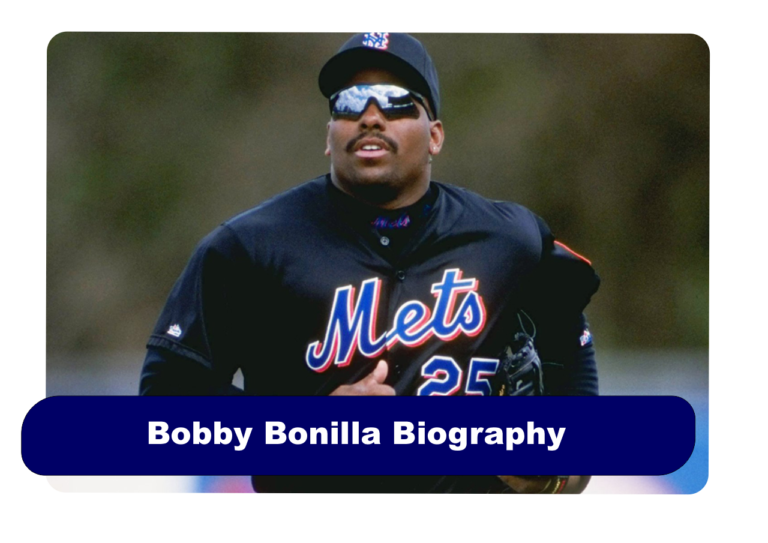
Bobby Bonilla is a 63-year-old retired MLB All-Star famous for his career stats, 1997 World Series win, and the legendary deferred contract known as Bobby Bonilla Day.
Bobby Bonilla is one of the most recognizable names in baseball — not only for what he did on the field, but for one of the most famous contracts in sports history. A six-time All-Star and 1997 World Series champion, Bonilla spent 16 seasons as one of the most feared switch-hitters in Major League Baseball. Today, he may be even more well-known for the annual July 1 payday that the New York Mets owe him through 2035 — a date the sports world now celebrates as “Bobby Bonilla Day.”
Born and raised in the Bronx to Puerto Rican parents, Bonilla climbed from an undrafted high school graduate to the highest-paid player in baseball at his peak. His story is one of resilience, power hitting, financial savvy, and a legacy that keeps paying — literally.
Quick Facts About Bobby Bonilla
| Detail | Information |
|---|---|
| Full name | Roberto Martin Antonio Bonilla |
| Date of birth | February 23, 1963 |
| Age (2026) | 63 years old |
| Birthplace | The Bronx, New York, USA |
| Nationality | American (Puerto Rican descent) |
| Profession | Retired MLB player; MLBPA special assistant |
| Career span | 1986–2001 |
| Teams | White Sox, Pirates, Mets, Orioles, Marlins, Dodgers, Braves, Cardinals |
| Net worth (2026) | Approximately $20 million |
| Current partner | Christina Solomon-Bonilla |
| Famous for | Six All-Star selections, 1997 World Series, Bobby Bonilla Day |
Early Life: Growing Up in the Bronx
Roberto Martin Antonio Bonilla was born on February 23, 1963, in the South Bronx, New York. His parents, Roberto Bonilla Sr. and Regina Bonilla, were Puerto Rican, and Bobby grew up roughly a mile from Yankee Stadium. He was raised alongside two twin sisters and a younger brother, in a household shaped by Puerto Rican culture and a deep love of baseball.
Bonilla attended Herbert H. Lehman High School in the Bronx, where he starred on the baseball diamond. Despite his obvious talent, he went undrafted in the 1981 MLB draft — an early rejection that would only fuel his determination. He briefly enrolled at the New York Institute of Technology in Old Westbury, pursuing a degree in computer science, but baseball had other plans.
A Pittsburgh Pirates scout named Syd Thrift spotted Bonilla at a baseball camp in Europe and signed him to the organization. That chance encounter set everything in motion. Bonilla worked his way through the Pirates’ farm system, and the long road to the major leagues had officially begun.
The Rise with the Pittsburgh Pirates
Bonilla made his MLB debut with the Chicago White Sox in 1986, but the Pirates quickly reacquired him later that season, where he would truly make his name. He started out as a third baseman, but after committing a significant number of errors, manager Jim Leyland shifted him to right field — a move that unlocked his potential.
In right field, Bonilla found his footing alongside Barry Bonds and Andy Van Slyke, forming one of the most dynamic outfields of the era. The trio helped the Pirates win three consecutive National League East titles from 1990 to 1992. Bonilla was a cornerstone of that run, earning Silver Slugger Awards and twice finishing in the top three for NL MVP voting. His 1990 season was particularly dominant — he led the league in extra base hits with 78, and his 1991 campaign saw him lead the NL in doubles with 44.
He was the first Pittsburgh Pirate to hit home runs from both sides of the plate in the same game, a fitting milestone for one of baseball’s premier switch-hitters. By the end of his time in Pittsburgh, Bonilla had established himself as one of the best players in the National League.
The Mets Contract and New York Years
After the 1991 season, Bonilla signed with the New York Mets in what was then the richest contract in baseball history — a five-year, $29 million deal that made him the highest-paid player in the sport. The $6.1 million he earned in 1992 exceeded the previous record by $2.3 million. Expectations in New York were enormous.
His tenure with the Mets was complicated. He remained a productive player individually, hitting a career-high 34 home runs in 1993 and earning two more All-Star selections, but the team struggled and the New York media proved relentless. His relationship with the press was contentious from day one — at his introductory press conference, he openly challenged reporters, setting the tone for a turbulent stay in the city.
He was traded to the Baltimore Orioles in 1995, helped them reach the American League Championship Series in 1996, and then signed a four-year, $23.3 million deal with the Florida Marlins ahead of the 1997 season. That year, he played a key role in the Marlins’ stunning run to their first World Series championship — one of the finest moments of his career.
Bobby Bonilla Day: The Contract That Never Ends
After stints with the Dodgers and a return to the Mets in 1999, Bonilla’s second run in New York ended on a sour note. He famously sat in the clubhouse playing cards with Rickey Henderson during Game 6 of the 1999 NLCS while the Mets were being eliminated by the Atlanta Braves — an image that followed him for years.
When the Mets released him after that season, they still owed him $5.9 million. Rather than pay it immediately, they struck a deal that has since become one of the most famous financial arrangements in sports history: the Mets would defer the payment for a decade and then pay Bonilla $1,193,248.20 every July 1 from 2011 through 2035, with 8% annual interest built in. The total payout: approximately $29.8 million on an original $5.9 million obligation.
Mets owner Fred Wilpon agreed to the deal in part because he believed his investments with Bernie Madoff were generating 10% annual returns, making the 8% interest arrangement seem like a bargain. When Madoff’s Ponzi scheme collapsed in 2008, the deal became a subject of broader inquiry — but for Bonilla, the checks have kept arriving every July 1 without interruption. The day has taken on a life of its own, celebrated annually with memes, media features, and genuine affection from sports fans worldwide. As Bonilla himself has said, it’s bigger than his own birthday. He also holds a separate deferred-payment arrangement with the Baltimore Orioles, paying him $500,000 annually from 2004 through 2028.
Career Statistics and Achievements
Bonilla retired in 2001 after a final season with the St. Louis Cardinals. His 16-year career numbers stand as a testament to sustained excellence:
| Stat | Career Total |
|---|---|
| Batting average | .279 |
| Home runs | 287 |
| RBIs | 1,173 |
| On-base percentage | .358 |
| Slugging percentage | .472 |
| All-Star selections | 6 |
| Silver Slugger Awards | 3 |
| World Series titles | 1 (1997, Florida Marlins) |
| Career earnings | Over $46 million |
He led the National League in extra base hits (1990) and doubles (1991), and his peak seasons put him in genuine MVP contention. His career home run total of 287 places him among the more productive power hitters of his generation.
Life After Baseball
Since retiring, Bonilla has remained connected to the sport as a special assistant for the Major League Baseball Players Association (MLBPA), where he serves as a spokesman for their Players Trust Playmakers Classic. He has appeared at various alumni and charitable events, and his annual July 1 payday keeps him in the sports news cycle every year without fail.
He currently lives in Sarasota, Florida, with his partner Christina Solomon-Bonilla. He was previously married to his high school sweetheart, Migdalia “Millie” Quinones, from 1986 until their divorce in 2009. They have two children together, and during his playing days the couple co-founded the Bobby & Millie Bonilla Public School Fund in 1992, donating $500 for every RBI Bonilla recorded as a Met.
Net Worth and Financial Legacy
As of 2026, Bobby Bonilla’s net worth is estimated at approximately $20 million. His income streams include the annual $1.19 million payment from the New York Mets (continuing through 2035), the $500,000 annual payment from the Baltimore Orioles, career earnings that surpassed $46 million, and real estate investments. The deferred Mets deal alone will total nearly $29.8 million by the time the final check arrives in 2035 — making it one of the best financial negotiations in sports history and a case study in the power of deferred compensation and compound interest.
Final Thoughts
Bobby Bonilla’s legacy is one of genuine duality. On the field, he was a dangerous, versatile hitter who helped franchises win and earned six All-Star berths over a 16-year career. Off the field, he negotiated a contract that has outlasted his playing days by decades and turned his name into an annual cultural event. Few athletes can claim that kind of double legacy.
In an era when athletes are frequently criticized for financial mismanagement, Bonilla’s story — however it unfolded — stands as a reminder that the fine print of a contract can matter as much as the salary itself. Every July 1, a new generation discovers the story, and Bobby Bonilla gets a little more famous. Not bad for a kid from the Bronx who went undrafted in 1981.
People Also Ask
What is Bobby Bonilla Day?
Bobby Bonilla Day falls on July 1 each year, when the New York Mets pay Bonilla $1,193,248.20 as part of a deferred salary agreement reached in 2000. The Mets deferred his remaining $5.9 million over 25 years at 8% interest, resulting in a total payout of approximately $29.8 million. Payments continue through 2035.
What teams did Bobby Bonilla play for?
Bonilla played for eight franchises over his 16-year career: the Chicago White Sox, Pittsburgh Pirates, New York Mets, Baltimore Orioles, Florida Marlins, Los Angeles Dodgers, Atlanta Braves, and St. Louis Cardinals. His most notable stints were with the Pirates and the Mets.
Did Bobby Bonilla win a World Series?
Yes. Bonilla was part of the 1997 Florida Marlins team that won the World Series, defeating the Cleveland Indians. It was the only championship of his playing career.
What is Bobby Bonilla’s career batting average?
Bonilla finished with a career batting average of .279, along with 287 home runs, 1,173 RBIs, a .358 on-base percentage, and a .472 slugging percentage across 16 MLB seasons.
What does Bobby Bonilla do now?
Bonilla currently serves as a special assistant for the Major League Baseball Players Association (MLBPA) and acts as a spokesman for the Players Trust Playmakers Classic. He lives in Sarasota, Florida, and remains a visible figure in baseball alumni circles.